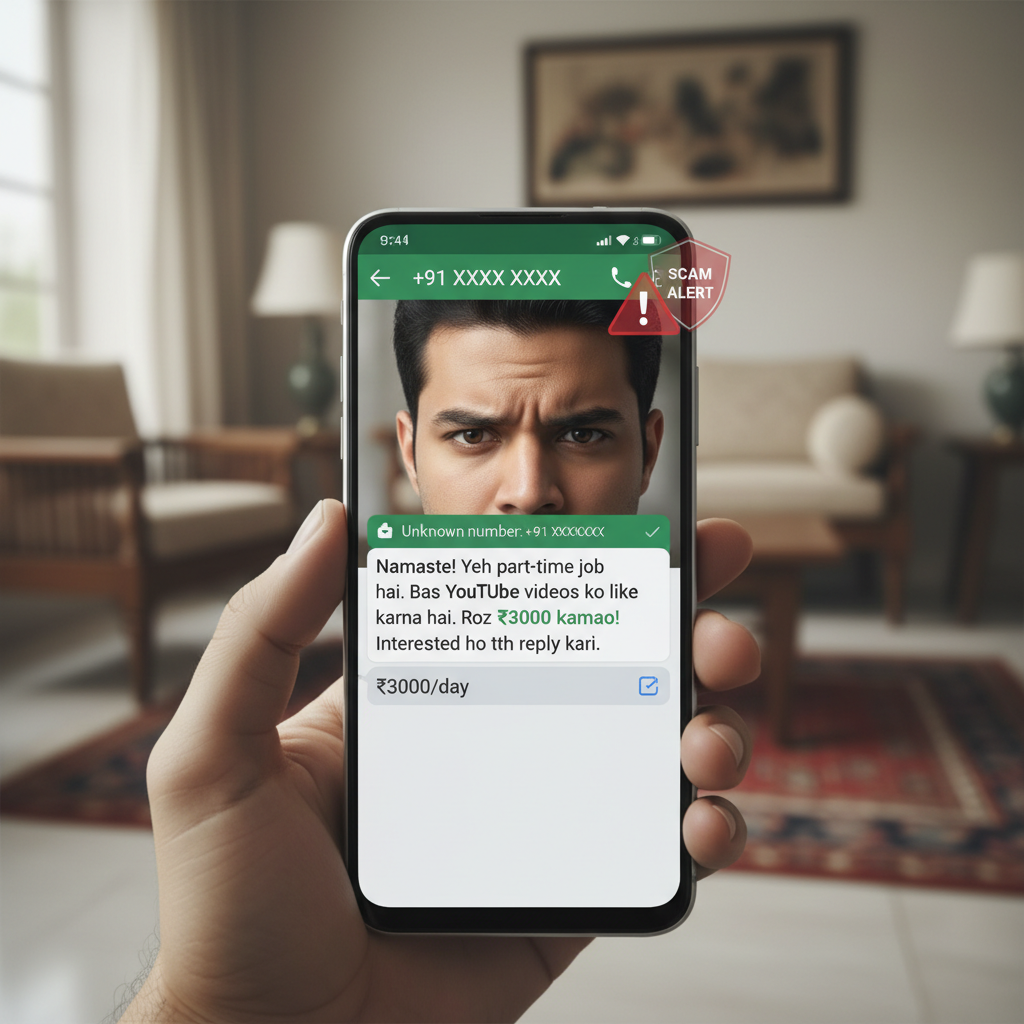
WhatsApp message "part-time job liking YouTube videos ₹3000/day" — is it real, what to do?
Be extremely wary of WhatsApp or Telegram messages offering high-paying, easy part-time jobs like liking YouTube videos. These are almost always sophisticated scams designed to steal your money, personal information, or even use you for illegal activities. While the initial payment might seem real, it's a trap leading to significant financial loss.
How This Scam Works
This scam preys on economic vulnerability and the desire for easy income, a common sentiment in India. It typically begins with an unsolicited message via WhatsApp or Telegram, often from an unknown international number or a seemingly innocuous Indian number. The message promises a lucrative "part-time job" – often liking YouTube videos, following social media accounts, or leaving positive reviews – with an incredibly attractive daily earning potential, like ₹3000 for just a few hours of work. Initially, the scammers might even pay you a small sum (e.g., ₹100-₹500) via UPI for completing a few simple tasks. This small payout is a crucial part of their manipulation; it builds trust and makes the victim believe the offer is legitimate. They might even guide you through installing a specific app or joining a private Telegram group where "job tasks" are posted. Once trust is established, the scam escalates. You will be asked to perform "premium tasks" or "investment tasks" that require an upfront payment. This could involve buying "recharge packs," "VIP memberships," or "task funds" to unlock higher-paying assignments. The scammers create fake dashboards that show your "earnings" increasing rapidly, further enticing you to invest more money. They might even pressure you by claiming that the "profits" are locked until a certain investment threshold is met. The payments are usually requested through UPI, bank transfers to individual accounts, or even cryptocurrency, making them hard to trace. Victims are often promised that their "investment" plus huge returns will be transferred back to their bank account after completing a set number of tasks. However, once a substantial amount is paid, the fraudsters either block the victim, delete the group, or simply vanish with the money. In some more elaborate versions, the scammers might also try to extract personal information (like Aadhaar details, PAN, or bank account numbers) under the guise of "KYC verification" or "payroll setup." This information can then be used for identity theft or other fraudulent activities. The ultimate goal is always financial exploitation, leveraging the initial small payment to reel in bigger deposits.
Red Flags
- Unsolicited Offers:** You received an offer out of the blue, especially from an unknown number on WhatsApp or Telegram, without applying for any job. Legitimate companies rarely recruit this way for basic, part-time roles.
- Too Good to Be True Earnings:** Promises of ₹3000 or more per day for minimal effort like liking YouTube videos are highly unrealistic. Real part-time jobs, even skilled ones, rarely offer such high returns for simple tasks.
- Initial Small Payouts:** While seemingly a positive sign, receiving a small payment for initial tasks is a classic tactic used by scammers to build trust before asking for larger sums.
- Requests for Upfront Payments/Investment:** Any job that requires you to pay money to start working, buy "packages," or "invest" to unlock higher earnings is a definite scam. Legitimate employers pay you; you don't pay them.
- Pressure and Urgency:** Scammers often create a sense of urgency, telling you that these high-paying tasks are limited or that you'll miss out if you don't invest immediately.
- Shady Communication Channels:** Communication primarily through WhatsApp/Telegram groups with anonymous admins and no official company website or email.
- Requests for Personal Documents:** Be wary if they ask for sensitive personal details like your entire Aadhaar number, PAN, or banking passwords for "KYC" without a clear, legitimate reason and a secure portal.
How to Stay Safe
- Verify the Sender:** If the offer comes from an unknown number, do not engage. Block and report it immediately. Legitimate companies will use official channels.
- Research the "Company":** Search online for the company name mentioned. Look for a professional website, official contact details, and reviews. If no credible information exists, it's likely a scam.
- Never Pay to Work:** Remember, legitimate jobs pay you, you don't pay them. Refuse any request for money, whether it's for training, materials, background checks, or unlocking premium tasks.
- Guard Personal Information:** Never share sensitive personal or financial information like your Aadhaar, PAN, bank account details, or OTPs with unknown individuals or unverified platforms.
- Trust Your Gut Instincts:** If an offer feels too good to be true, it almost certainly is. Listen to that voice of caution.
- Report Suspicious Messages:** Utilize the reporting features within WhatsApp and Telegram to flag these deceptive messages and help protect others.
If You Are Targeted
- Stop All Communication Immediately:** As soon as you realize it's a scam, cease all interaction with the fraudsters. Do not send any more money or information.
- Block and Report:** Block the sender's number on WhatsApp/Telegram and report the chat.
- Screenshot Everything:** Take screenshots of the messages, the fake payment dashboards, the UPI transaction details, and any other relevant information. This will be crucial evidence.
- Report to Cyber Crime (India):** File a complaint immediately on the Indian Cyber Crime Reporting Portal: `cybercrime.gov.in` or call the national helpline 1930. Provide all the evidence you have collected.
- Inform Your Bank/Payment Service Provider:** If you have made any payments, contact your bank or UPI service provider immediately to report the fraudulent transactions. They might be able to help reverse some transactions, especially if reported quickly.
- Alert Loved Ones:** Share your experience with family and friends to prevent them from falling victim to similar scams.
ScamGuard24 Insight
This scam's success lies in its initial "proof of concept" payment, which cleverly disarms skepticism. Victims often conflate these small, real payouts with legitimacy, overlooking the fundamental red flags of requiring investment for work. It's a calculated psychological manipulation designed to extract far greater sums.
Suspect a scam right now?
Open ScamGuard24 ScannerRecommended protection tools
AffiliateWe may earn a small commission if you sign up — it never changes our editorial picks.
India's most trusted antivirus. Blocks malicious APKs, UPI phishing and fake banking apps.
Get Quick HealAll-in-one mobile security + VPN. Stops phishing links shared on WhatsApp and SMS.
Try Norton 360Stop reusing passwords. Auto-fills only on the real bank site, never on phishing pages.
Get NordPass


Comments
Be the first to comment.