
WhatsApp message "like YouTube videos earn ₹3000" – is it real? What to do?
Fraudsters are using WhatsApp and Telegram to lure unsuspecting individuals with fake part-time job offers, promising easy money for simple tasks like liking YouTube videos. These scams aim to extract personal information, bank details, or trick victims into paying "registration fees" or making initial "investments" that are never returned. They exploit the desire for quick income and can lead to significant financial losses.
How This Scam Works
The scam typically begins with an unsolicited message on WhatsApp or Telegram, often from an unknown number. The message usually presents an attractive part-time job opportunity, claiming you can earn a substantial daily income, often ₹3000 or more, for minimal effort. The most common task mentioned is "liking YouTube videos," "subscribing to channels," or "giving positive reviews." Once you express interest, the scammer, posing as a "recruiter" or "task manager," will engage you further. They might direct you to a private Telegram group or another chat platform where they provide seemingly legitimate tasks. Initially, they might even pay you a small amount (e.g., ₹100-₹200) for completing a few tasks, building your trust and making the offer seem credible. This initial payment is a classic psychological manipulation tactic known as "bait-and-switch." As you continue, they will introduce "premium tasks" or "investment tasks" that promise much higher returns. These tasks invariably require you to deposit a certain amount of money into a specified bank account or UPI ID. The reasons given for these deposits vary: it could be a "security deposit," "platform activation fee," "KYC verification fee," or an "investment" to unlock more lucrative tasks. They will present fabricated "rules" or "policies" stating that funds must be deposited to proceed. Once the money is transferred, the scammer will either vanish, block you, or continue to demand more payments for various fabricated reasons (e.g., "tax fees," "withdrawal charges," "technical issues"). They might even create fake dashboards or apps to show inflated "earnings" that you can never withdraw. They leverage urgency and the fear of losing the initial "investment" to pressure victims into making more payments. They often ask for sensitive personal information like Aadhaar details or bank account numbers under the guise of "KYC verification" or "salary processing," which can then be used for identity theft or further financial fraud.
Red Flags
- Unsolicited & Too-Good-To-Be-True Offers:** Any message promising high daily income (e.g., ₹3000/day) for minimal effort like liking videos, especially from unknown numbers, is a huge red flag. Legitimate job offers don't typically appear out of the blue on personal chat apps.
- Requests for Upfront Payments/Deposits:** No genuine employer will ask you to pay money to get a job, for "activiation fees," "security deposits," "KYC verification," or "investment" to start earning. This is the cornerstone of almost all online job scams.
- Vague Job Descriptions & Company Information:** Scammers avoid giving clear details about the company, its legitimate website, or official contact information. They operate with pseudonyms and generic profiles.
- Pressure to Act Quickly & Urgency:** Scammers often create a sense of urgency, pressuring you to make decisions or transfer money immediately, often by stating that the "opportunity is limited" or "task window is closing."
- Communication Solely on Messaging Apps:** Legitimate recruitment involves professional communication channels like official company emails, recruitment portals, and sometimes phone calls, not exclusively WhatsApp or Telegram.
- Requests for Personal Financial Information:** Be wary if they ask for your full bank account number, UPI PIN, OTPs, or credit card details under the guise of "processing payments" or "KYC."
How to Stay Safe
- Verify the Source:** Always verify the authenticity of job offers. Check the company's official website, look for legitimate contact details, and cross-reference information. If the offer comes from an unofficial channel, chances are it's a scam.
- Never Pay for a Job:** Remember, legitimate jobs pay you, you don't pay for them. Any request for money upfront—be it for registration, training, security deposit, or anything else—is a scam.
- Be Skeptical of "Easy Money" Schemes:** If an offer sounds too good to be true, it almost certainly is. Genuine income requires effort and legitimate work.
- Protect Your Personal Information:** Never share sensitive personal details like your Aadhaar number, PAN, bank account details, UPI PIN, or OTPs with unknown individuals or unverified platforms.
- Report and Block:** If you receive such a message, block the number immediately and report it to WhatsApp/Telegram. This helps protect others from falling victim.
- Educate Yourself and Others:** Share awareness about these scams with your friends and family, especially those who might be more susceptible to such "easy money" promises.
If You Are Targeted
- Do Not Engage Further:** As soon as you suspect a scam, stop all communication with the scammer. Do not try to "get your money back" by engaging with their new demands, as this will only lead to further losses.
- Gather Evidence:** Take screenshots of all messages, transaction details (UPI IDs, bank transfer information), and any other communication. This evidence will be crucial if you decide to report the scam.
- Report to Cyber Crime (1930 / cybercrime.gov.in):** Immediately report the incident to the National Cybercrime Helpline at 1930 or file a complaint on the official portal cybercrime.gov.in. Provide all the evidence you've gathered.
- Contact Your Bank/Payment Service Provider:** If you have transferred money, inform your bank or UPI service provider immediately. They might be able to help trace the transaction or freeze the recipient's account, especially if reported quickly.
- Change Passwords (If applicable):** If you shared any account details or passwords (though you shouldn't), change them immediately for all affected services.
ScamGuard24 Insight
These "tasking scams" are a sophisticated evolution of traditional advance-fee fraud, leveraging micro-payments and gamification to build trust before demanding larger sums. The initial small payouts are a calculated psychological trick designed to overcome initial skepticism and establish false credibility.
Suspect a scam right now?
Open ScamGuard24 ScannerRecommended protection tools
AffiliateWe may earn a small commission if you sign up — it never changes our editorial picks.
India's most trusted antivirus. Blocks malicious APKs, UPI phishing and fake banking apps.
Get Quick HealAll-in-one mobile security + VPN. Stops phishing links shared on WhatsApp and SMS.
Try Norton 360Stop reusing passwords. Auto-fills only on the real bank site, never on phishing pages.
Get NordPass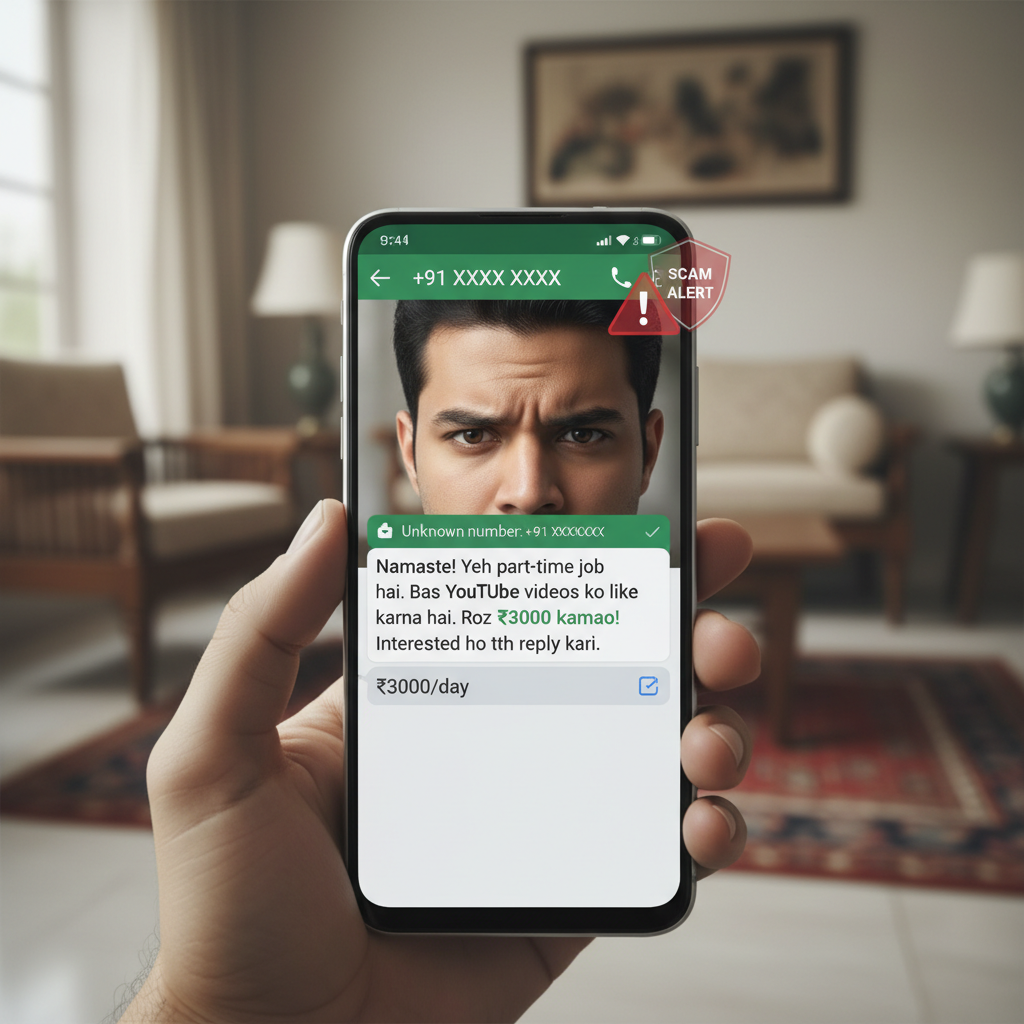


Comments
Be the first to comment.