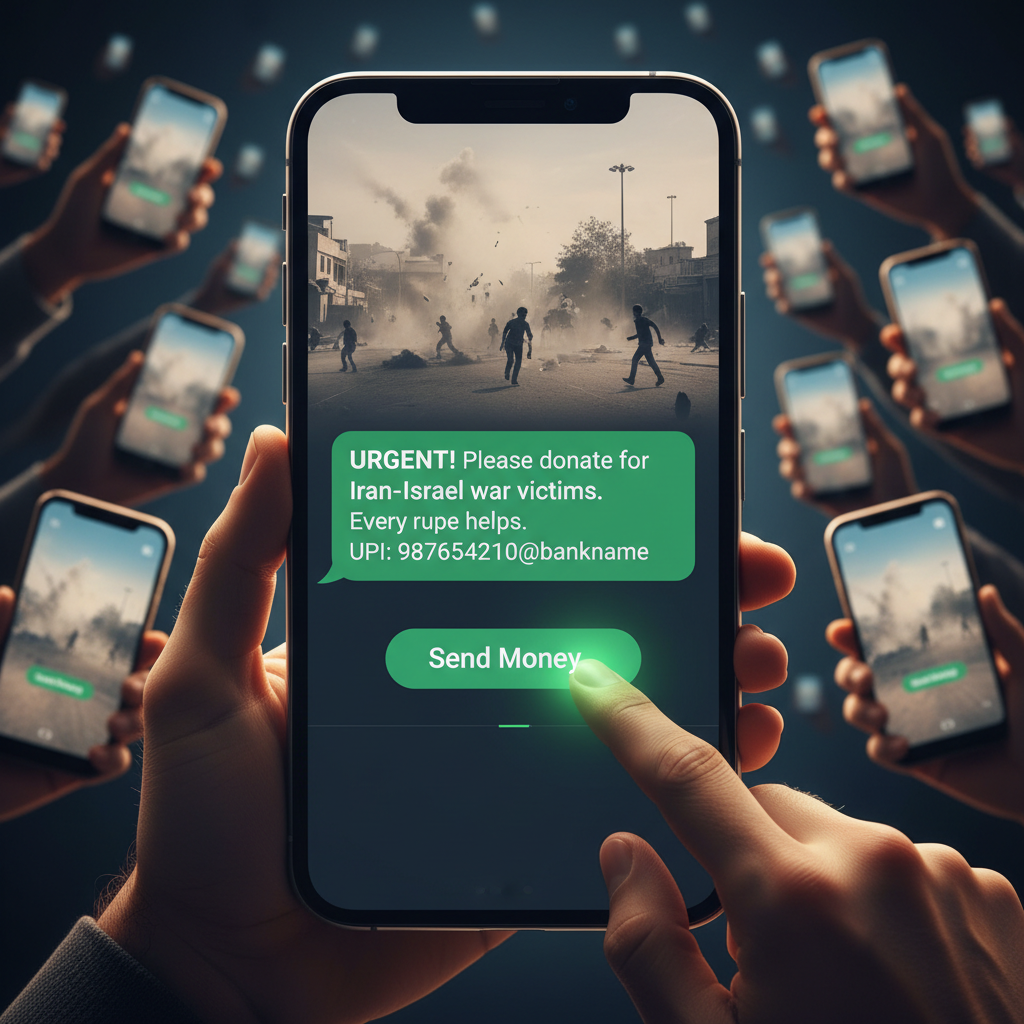
WhatsApp ‘Iran War Help’ UPI Donation Messages – Is It Real or Scam? What to Do.
Scammers are exploiting global conflicts by circulating fake charity appeals on WhatsApp and Instagram, particularly targeting the ongoing Iran-Israel war. They request UPI donations for "displaced families and children," often using real images, but the funds go to personal accounts. This high-risk scam preys on your empathy to steal your hard-earned money.
How This Scam Works
The scam typically begins with an emotionally charged message sent via WhatsApp groups, individual chats, or shared as a story/post on Instagram. These messages appeal directly to your compassion, highlighting the plight of those caught in the ongoing Iran-Israel conflict. The core of the message is a plea for financial assistance, often mentioning "displaced families," "orphaned children," or "medical aid" urgently needed by victims of the war. To make these appeals seem legitimate, scammers often embed or attach distressing images or even short video clips portraying what appears to be genuine suffering and destruction. These visuals are meticulously chosen to evoke strong emotional responses, making the donation request feel urgent and necessary. They might be repurposed from actual news reports, old conflicts, or entirely fabricated scenarios, all designed to bypass your critical thinking. The crucial element of the scam is the donation method: Unified Payments Interface (UPI). The message will include a personal UPI ID (e.g., anubhav.kumar@oksbi, pooja.sharma@ybl) or a QR code that, when scanned, links to a personal account, not an official charity's account. This is a significant red flag, as legitimate charities, especially those involved in international aid, operate through registered bank accounts and official online payment gateways, not personal UPI IDs. Sometimes, scammers might even create a sense of urgency by claiming a "matching donor" will double your contribution or that funds are needed by a specific deadline. They leverage the instant nature of UPI transactions, knowing that once the money is sent, especially to a personal account, it is exceedingly difficult, if not impossible, to recover. They might also pressure you to forward the message to your contacts, effectively turning you into an unwitting accomplice in spreading the scam within your network. The anonymity and ease of sharing on platforms like WhatsApp and Instagram make these platforms ideal for such fraudulent schemes to proliferate rapidly across India.
Red Flags
- Personal UPI IDs for Donations:** Any charity requesting donations to a personal UPI ID (e.g., mobilenumber@bankname or an individual's name@bankname) is a scam. Genuine charities have registered organizational bank accounts and unique payment gateways.
- Highly Emotional Language & Impoverished Images:** Messages that excessively tug at your heartstrings with overly dramatic language and graphic images of suffering, especially without verifiable sources, are a common scam tactic.
- Lack of Official Charity Information:** Absence of an official charity name, registration number, website link, or details on how funds will be utilized are major warning signs. Legitimate organizations are transparent.
- Pressure to Act Quickly:** Scammers often create a false sense of urgency, urging you to donate "immediately" or "before it's too late," to prevent you from conducting proper due diligence.
- Unsolicited Messages from Unknown Numbers:** Receiving donation requests from numbers you don't recognize, especially those forwarded multiple times, should raise immediate suspicion.
- Spelling Errors and Poor Grammar:** While not exclusive to scams, many fraudulent messages contain noticeable grammatical mistakes or awkward phrasing, often indicative of non-professional origins.
How to Stay Safe
- Verify, Verify, Verify:** Before donating to any cause, always verify the authenticity of the organization. Look for their official website, registration details, and contact information. Cross-reference with credible international aid organizations or government advisories.
- Donate to Reputable Charities:** Only donate to well-established, registered charities that have a proven track record of humanitarian aid and transparent financial reporting. Look for organisations recognised by the Indian government or international bodies like the UN.
- Avoid UPI for Unverified Charities:** Never send money to a personal UPI ID from an unverified source, especially for charity. If a legitimate charity uses UPI, it will be linked to their registered organisational account, not an individual.
- Check Official Sources for War-Related Aid:** If you wish to donate for international conflicts, look for official appeals from government bodies, the Indian Red Cross, UNICEF, or other major international NGOs.
- Report Suspicious Messages:** If you receive such a message on WhatsApp or Instagram, report it immediately to the platform. Do not forward it under any circumstances, even with a warning.
- Educate Your Network:** Share this information with your family and friends, especially older relatives who might be more susceptible to emotional appeals.
If You Are Targeted
- Do Not Engage or Respond:** The best course of action is to ignore and block the sender. Do not click on any links, make calls, or respond to the message in any way.
- Report to Platform:** On WhatsApp, use the "Report" function for the chat or group. On Instagram, report the post or profile for "scam or fraud."
- Report to Cybercrime India:** File a complaint immediately on the National Cybercrime Reporting Portal (cybercrime.gov.in) or call the helpline 1930. Provide all details, including screenshots of the message and the UPI ID.
- Inform Your Bank:** If you have already transferred money, contact your bank's fraud department immediately to report the unauthorized transaction. While recovery is difficult, prompt action increases your chances.
- Gather Evidence:** Take screenshots of the messages, the UPI ID, and any other relevant information. This evidence will be crucial if you need to file a formal complaint.
ScamGuard24 Insight
This scam capitalizes on human empathy during times of global crisis, making it particularly insidious. Always remember that legitimate aid organizations will never solicit funds via personal UPI accounts on social media platforms; their donation channels are always official and transparent. Your vigilance is the first line of defense against being financially exploited.
Suspect a scam right now?
Open ScamGuard24 ScannerRecommended protection tools
AffiliateWe may earn a small commission if you sign up — it never changes our editorial picks.
India's most trusted antivirus. Blocks malicious APKs, UPI phishing and fake banking apps.
Get Quick HealAll-in-one mobile security + VPN. Stops phishing links shared on WhatsApp and SMS.
Try Norton 360Stop reusing passwords. Auto-fills only on the real bank site, never on phishing pages.
Get NordPassRelated alerts
WhatsApp Iran War Charity UPI Scam — is it real, what to do about strange requests?
WhatsApp forward Iran-Israel war charity plea Indian UPI — is it real?
 HIGH RISK
Comments
Be the first to comment.