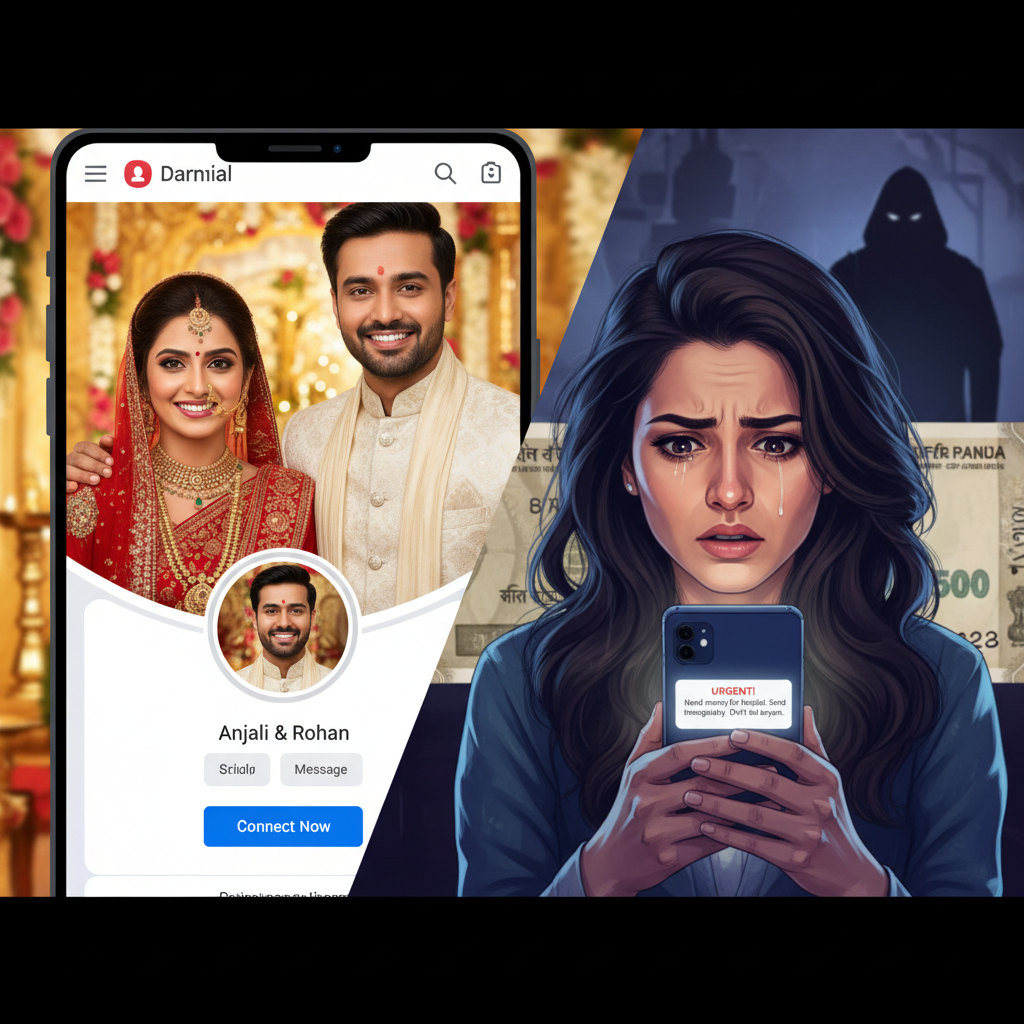
Shaadi.com match asking for emergency money after a few weeks — what to do?
This alert exposes the growing trend of matrimonial fraud where scammers build trust on popular Indian matrimonial sites like Shaadi.com, only to later request urgent financial assistance. They exploit emotional vulnerabilities to con unsuspecting individuals out of their hard-earned money, often disappearing once the funds are transferred.
How This Scam Works
Matrimonial sites in India, such as Shaadi.com, Bharat Matrimony, and Jeevansathi, have become popular platforms for individuals seeking life partners. Unfortunately, these platforms also attract sophisticated fraudsters who prey on the hopes and desires of genuine users. The matrimonial fraud scam typically unfolds in several stages, meticulously designed to build trust before exploiting it for financial gain. Initially, the scammer creates an elaborate and often very convincing profile. This profile usually includes attractive photos, details about a stable career (often abroad or in a high-paying sector like IT, engineering, or medicine), and a seemingly desirable family background. They might claim to be an NRI (Non-Resident Indian) working in the US, UK, Canada, or Gulf countries, as this provides a convenient excuse for geographical distance and potential difficulties in meeting in person early on. The language used in their profile and initial communication is designed to be charming, respectful, and reflective of traditional Indian values, making them appear trustworthy and sincere. Once a connection is made, the scammer initiates conversation, often through the platform's messaging system, quickly moving to personal communication channels like WhatsApp or regular phone calls. They invest significant time and effort in building a strong emotional rapport. This involves daily conversations, sharing personal stories (often fabricated), expressing strong interest, and even discussing future plans like marriage and family. They might use techniques like "love bombing," where they shower the victim with excessive affection and attention, making the victim feel incredibly special and desired. This phase can last for several weeks or even months, cementing a sense of deep connection and trust. After establishing a significant emotional bond, the scammer introduces a fabricated "emergency" situation. This emergency is always presented as urgent, unpredicted, and requiring immediate financial intervention. Common scenarios include: * **Medical Emergency:** A sudden illness or accident involving a family member (parent, sibling, or even themselves) requiring expensive treatment. They might claim to be stuck in a foreign country where medical costs are exorbitant, or that their insurance isn't covering the full amount. * **Business Opportunity/Crisis:** A crucial business deal that requires immediate capital infusion, or a business associate defaulting on a payment, jeopardizing their entire enterprise. They might promise to include the victim in the profits once the crisis is averted. * **Travel Issues:** They might claim to be arriving in India to meet the victim but get stranded at the airport due to visa issues, customs problems, or flight cancellations, requiring funds for "on-the-spot" payments. * **Legal Difficulties:** False arrest, legal fees, or administrative penalties in a foreign country, requiring urgent money to avoid dire consequences. The request for money is always framed as a temporary loan, with promises of immediate repayment once their "situation" is resolved or they gain access to their own substantial funds (which are conveniently tied up). They will leverage the emotional bond they've built, appealing to the victim's kindness, sense of responsibility, and the perceived "love" between them. They might use guilt trips, express profound distress, or even act desperate. The scammer will provide details for transferring money, often requesting multiple smaller transactions rather than one large sum to avoid detection, or asking for payments via UPI, bank transfer, or even gift cards. They might insist on anonymity or using specific channels, claiming it’s for "security" or "to avoid attention." Once the money is sent, the scammer either makes excuses for needing more funds, or more commonly, completely disappears, blocking all communication channels and deleting their profile. The victim is left heartbroken, financially depleted, and often deeply embarrassed. The key to this scam's effectiveness lies in the scammer's ability to patiently build an emotional connection and then exploit the inherent trust and emotional investment a person makes when seeking a life partner.
Red Flags
- Rapid Progression of Relationship:** They declare strong feelings, discuss marriage, and make future plans very quickly, often within weeks, without having met in person.
- Avoidance of In-Person Meetings/Video Calls:** They consistently make excuses for not being able to meet or participate in video calls, often citing distance, work, or technical difficulties.
- Elaborate and Perfect Profile:** Their profile seems too good to be true, with an impressive career, perfect photos (sometimes stock photos), and a well-crafted backstory.
- Sudden "Emergency" Requiring Funds:** After building trust, a sudden, urgent crisis arises that *only* money from you can solve, often involving health, legal issues, or travel.
- Requests for Money Transfer:** They ask you to send money via UPI, bank transfer, gift cards, or other untraceable methods, even if they claim to be wealthy. No legitimate match should ever ask for money.
- Pressure and Guilt Tactics:** They use emotional manipulation, guilt-tripping, or dire warnings about negative consequences if you don't send money immediately.
- Inconsistent Stories or Details:** Pay attention to inconsistencies in their stories, names, locations, or other details. Scammers often forget their own fabricated narratives.
- Poor Language/Grammar (despite claiming good education):** Sometimes, underlying grammatical errors or awkward phrasing can be a giveaway, especially if they claim to be highly educated or an NRI.
How to Stay Safe
- Never Send Money:** The cardinal rule – never, under any circumstances, send money or financial details (like bank account numbers, OTPs, or credit card info) to someone you haven't met in person and thoroughly vetted.
- Insist on Video Calls and In-Person Meetings:** Before forming a deep emotional connection, insist on several video calls. If they refuse, raise a red flag. If possible, endeavor to meet in a public place.
- Verify Information Independently:** Use search engines, social media, and reverse image searches to verify details shared by the person. Look for inconsistencies in their online presence. Check their background details.
- Be Skeptical of "Too Good to Be True" Profiles:** If a profile seems extraordinarily perfect, approach it with caution. Scammers often create idealized personas.
- Talk to Trusted Friends and Family:** Discuss the relationship with close friends or family members. An objective outside perspective can often spot red flags you might miss due to emotional involvement.
- Report Suspicious Profiles:** If you encounter a suspicious profile or are targeted by a scammer, report them immediately to the matrimonial platform's support team.
- Educate Yourself:** Stay informed about common scam tactics. Awareness is your best defense.
If You Are Targeted
- Stop All Communication Immediately:** As soon as you suspect a scam, block the person on all channels (matrimonial site, WhatsApp, phone, email).
- Do Not Send Any More Money:** Even if you've already sent some money, do not send any more, no matter how desperate or urgent their pleas are.
- Collect All Evidence:** Screenshot conversations, profile details, transaction records, and any other communication. This evidence will be crucial for reporting.
- Report to Platform:** Inform the matrimonial site (e.g., Shaadi.com) about the scammer with all collected evidence.
- Report to Cybercrime India:** File a complaint with the National Cybercrime Reporting Portal (cybercrime.gov.in) or call their helpline at 1930. Provide all collected evidence.
- Inform Your Bank:** If you transferred money via bank transfer or UPI, immediately contact your bank to report the fraudulent transaction. They may be able to assist in tracing or reversing the funds, though success is not guaranteed.
ScamGuard24 Insight
This scam thrives on emotional manipulation and is a prime example of how fraudsters leverage platforms meant for genuine connections. Always prioritize financial safety over emotional impulsivity, and remember that any legitimate partner would never put you in a position where you feel pressured to send money.
Suspect a scam right now?
Open ScamGuard24 ScannerRecommended protection tools
AffiliateWe may earn a small commission if you sign up — it never changes our editorial picks.
India's most trusted antivirus. Blocks malicious APKs, UPI phishing and fake banking apps.
Get Quick HealAll-in-one mobile security + VPN. Stops phishing links shared on WhatsApp and SMS.
Try Norton 360Stop reusing passwords. Auto-fills only on the real bank site, never on phishing pages.
Get NordPassRelated alerts
 MEDIUM
Shaadi.com Match Asking for Emergency Money - Is it a Scam, What to Do?
 MEDIUM
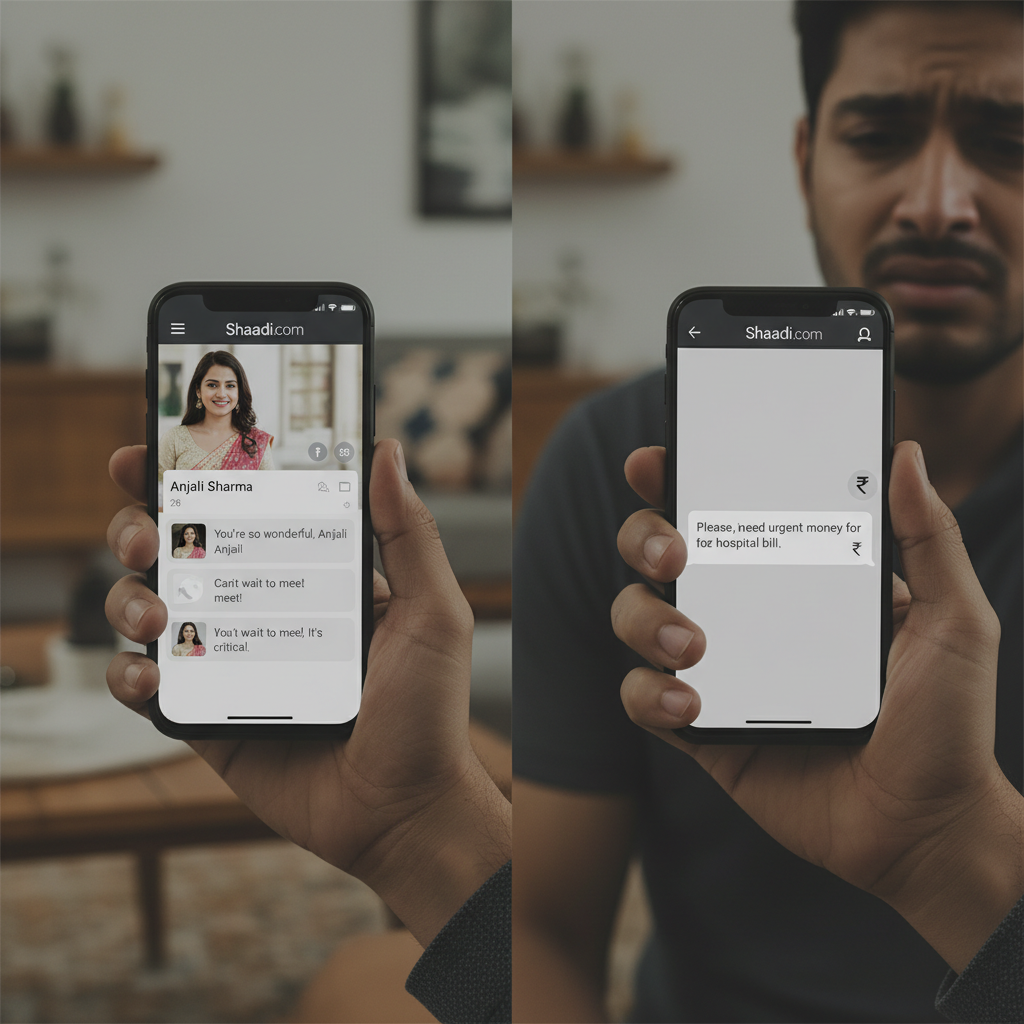
Shaadi.com match asking for emergency money - is it a scam? How to check in India.
 MEDIUM
Comments
Be the first to comment.