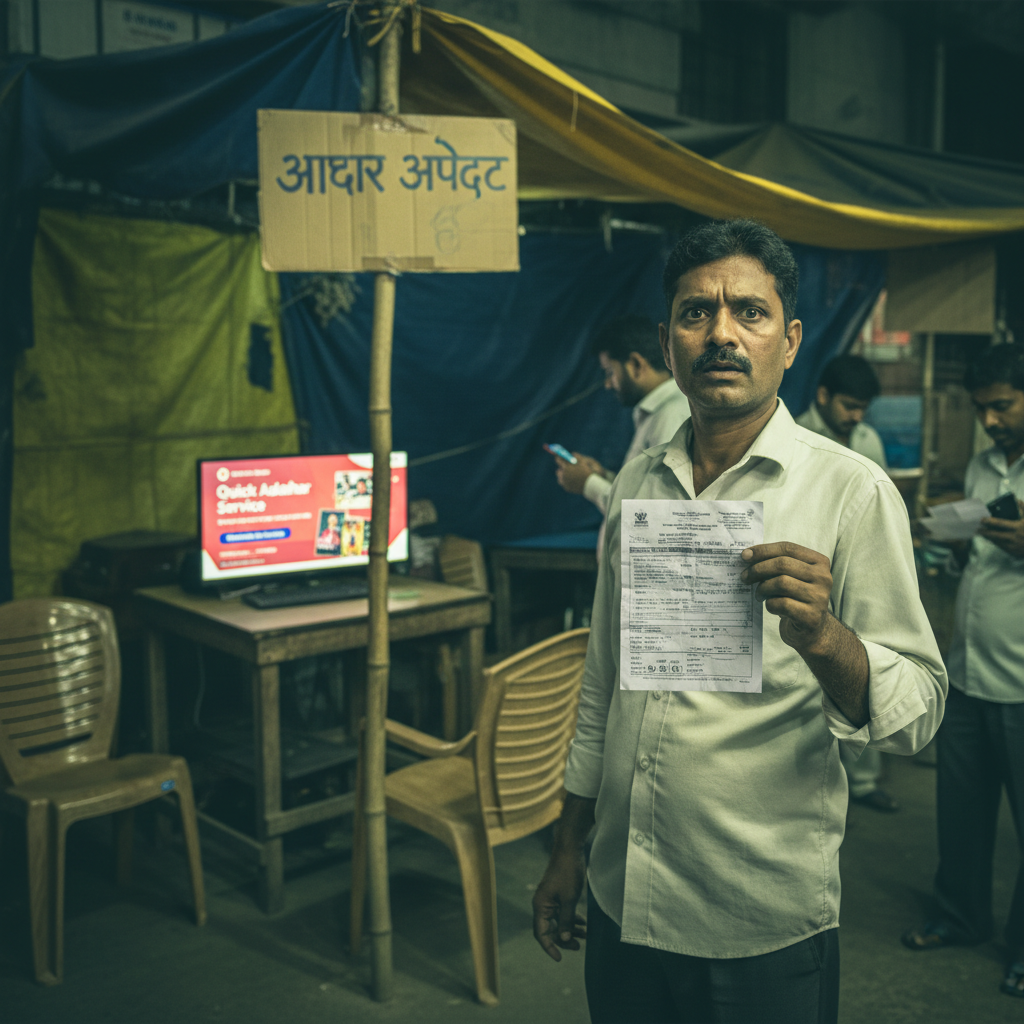
Fake Aadhaar Update Centre near me — is it real? How to check?
Beware of fraudulent centres or agents promising quick Aadhaar enrolment or updates. These scams often steal your personal data and money without providing any legitimate service, leaving you vulnerable to further identity theft. Always verify the authenticity of any Aadhaar service provider to protect your sensitive information.
How This Scam Works
In India, the Aadhaar card is an indispensable document, serving as proof of identity and address for a multitude of services, from banking and mobile connections to government schemes. Its importance makes it a prime target for fraudsters looking to exploit individuals' urgent needs for enrolment or updates. This scam primarily operates by creating an illusion of legitimate service, preying on those who might find the official process daunting or slow. The elaborate scheme typically begins with attractive advertisements. These might pop up on your social media feeds, appear as sponsored links in search engine results, or even be distributed through local agents in bustling markets or residential areas. The ads promise a "fast-track" Aadhaar enrolment or an "instant" update service, often at a seemingly affordable price, such as ₹500. This price point is carefully chosen – it's low enough to be appealing and not immediately suspicious, yet significant enough for fraudsters to make a profit from numerous victims. Once a victim expresses interest, they are directed to a physical location or asked to share details online. The "centre" might be set up in a rented shop, a temporary kiosk, or even a residential premise, giving it a veneer of legitimacy. These locations are often short-lived, designed to operate for a few weeks or months before disappearing. The agents staffing these centres are often convincing, appearing professional and knowledgeable about the Aadhaar process. The victim is then asked to provide a host of personal information – their name, address, date of birth, biometric data (fingerprints, iris scan), and sometimes even copies of other identity documents. They might also be asked to pay the advertised fee upfront, often in cash or via a quick UPI transfer. The fraudster then simulates an enrolment or update process, perhaps even providing a fake acknowledgement slip or receipt. However, the reality is starkly different. The centre is not authorized by the Unique Identification Authority of India (UIDAI), and the "service" provided is entirely bogus. The biometric and demographic data collected is not forwarded to UIDAI; instead, it is harvested by the scammers. This highly sensitive information can then be used for various nefarious activities, including identity theft, opening bank accounts in the victim's name, applying for loans, or even selling the data on the dark web. The victim receives no Aadhaar card or updated details, and when they try to follow up, the centre has often vanished, or the contact numbers are disconnected. This scam highlights a critical vulnerability: the public's reliance on quick and easy solutions for essential government services. It leverages the genuine need for Aadhaar services against unsuspecting individuals, turning a crucial identification process into a mechanism for fraud and data theft.
Red Flags
- Unusual Advertisement Channels:** Be wary of Aadhaar enrolment/update services advertised solely through online ads (especially on social media like Facebook, Instagram, or through pop-ups) or local, unsolicited agents who approach you in public places or via WhatsApp messages. Official services are typically announced by UIDAI.
- Promise of "Instant" or "Fast-Track" Services:** UIDAI has established procedures for Aadhaar enrolment and updates, which involve specific processing times. Any centre or agent promising "instant" Aadhaar card generation or "fast-track" updates for an extra fee is highly suspicious.
- Requests for Fees Exceeding Official Charges:** UIDAI has fixed fees for Aadhaar services. Enrolment is free, and updates (like demographic updates or biometric updates) have a nominal, fixed fee (e.g., ₹50 for demographic updates, ₹100 for biometric updates). If an agent demands ₹500 or any amount significantly higher than the official charges for any service, it's a scam.
- Lack of Official UIDAI Branding/Authorisation:** Legitimate Aadhaar Seva Kendras (ASKs) or authorised enrolment centres prominently display UIDAI branding, their enrolment agency name, and often have a valid certificate of authorisation. If a centre lacks clear official signage, proper infrastructure, or is operating out of a temporary setup without visible UIDAI affiliation, be extremely cautious.
- Unsolicited Calls/Messages Offering Services:** If you receive unprompted calls, SMS, or WhatsApp messages offering Aadhaar update services, especially if they pressure you for immediate action or ask for personal details over the phone, it is a significant red flag. UIDAI does not typically reach out this way for service offerings.
How to Stay Safe
- Use Only Official UIDAI Channels:** Always visit an authorised Aadhaar Seva Kendra (ASK) or a permanent Aadhaar enrolment/update centre. You can find the nearest official centre using the "Locate an Enrolment & Update Centre" tool on the official UIDAI website (uidai.gov.in) or through the mAadhaar app.
- Verify Centre Authenticity:** Before visiting, cross-check the details of any centre you find online or through local recommendations with the official UIDAI website. Look for valid addresses, contact numbers, and official UIDAI affiliation.
- Understand Official Fees:** Familiarise yourself with the standard fees for various Aadhaar services as published on the UIDAI website. Refuse to pay any amount exceeding these official charges. Keep in mind that Aadhaar enrolment is free.
- Protect Your Biometrics and OTPs:** Never share your Aadhaar number, OTP (One-Time Password) received on your registered mobile number, or allow anyone other than authorised UIDAI personnel to take your fingerprints or iris scans at unverified locations. Biometric data is critical for identity verification.
- Be Skeptical of "Guarantees":** No legitimate service provider can guarantee an Aadhaar card or update within an unrealistic timeframe. The process is managed by UIDAI, and processing times are subject to their protocols.
- Report Suspicious Activity:** If you encounter any suspicious ads, agents, or centres claiming to offer Aadhaar services, report them immediately to UIDAI through their helpline (1947) or website.
If You Are Targeted
- Immediately Secure Other Accounts:** If you suspect your Aadhaar data has been compromised, urgently monitor your bank accounts, credit reports, and other financial activities for any suspicious transactions or new accounts opened in your name.
- Lock Your Aadhaar Biometrics:** Use the UIDAI website (uidai.gov.in) or the mAadhaar app to lock your Aadhaar biometrics. This prevents any further misuse of your fingerprints or iris scans for authentication purposes unless you unlock them.
- File a Police Complaint:** Lodge a First Information Report (FIR) with your local police station, detailing the incident, the location of the fake centre (if applicable), and any information about the fraudsters. Provide copies of any fake receipts or acknowledgement slips you may have received.
- Contact UIDAI:** Report the fraudulent centre or agent to the UIDAI helpline (1947) and through their grievance redressal mechanism on the official website. This helps them identify and shut down illegal operations.
- Inform Your Bank:** If you suspect your Aadhaar was used to open fraudulent bank accounts, inform your bank and request a thorough investigation.
- Change Passwords:** If you used any common passwords for any online services related to sharing your Aadhaar data, change them immediately.
ScamGuard24 Insight
The proliferation of fake Aadhaar centres is a significant threat to digital security and personal privacy in India. This scam underscores the critical importance of digital literacy and verification, as fraudsters leverage both online platforms and local community presence to exploit trust and urgency. Always remember that official government services will adhere to official protocols and charges, and any deviation should be a major red flag demanding extreme caution.
Suspect a scam right now?
Open ScamGuard24 ScannerRecommended protection tools
AffiliateWe may earn a small commission if you sign up — it never changes our editorial picks.
India's most trusted antivirus. Blocks malicious APKs, UPI phishing and fake banking apps.
Get Quick HealAll-in-one mobile security + VPN. Stops phishing links shared on WhatsApp and SMS.
Try Norton 360Stop reusing passwords. Auto-fills only on the real bank site, never on phishing pages.
Get NordPassRelated alerts
 HIGH RISK
WhatsApp task scam India: liking videos for money, is it real?
 HIGH RISK
WhatsApp SEBI stock tips DMAT account scam – is it real?
 HIGH RISK
Comments
Be the first to comment.