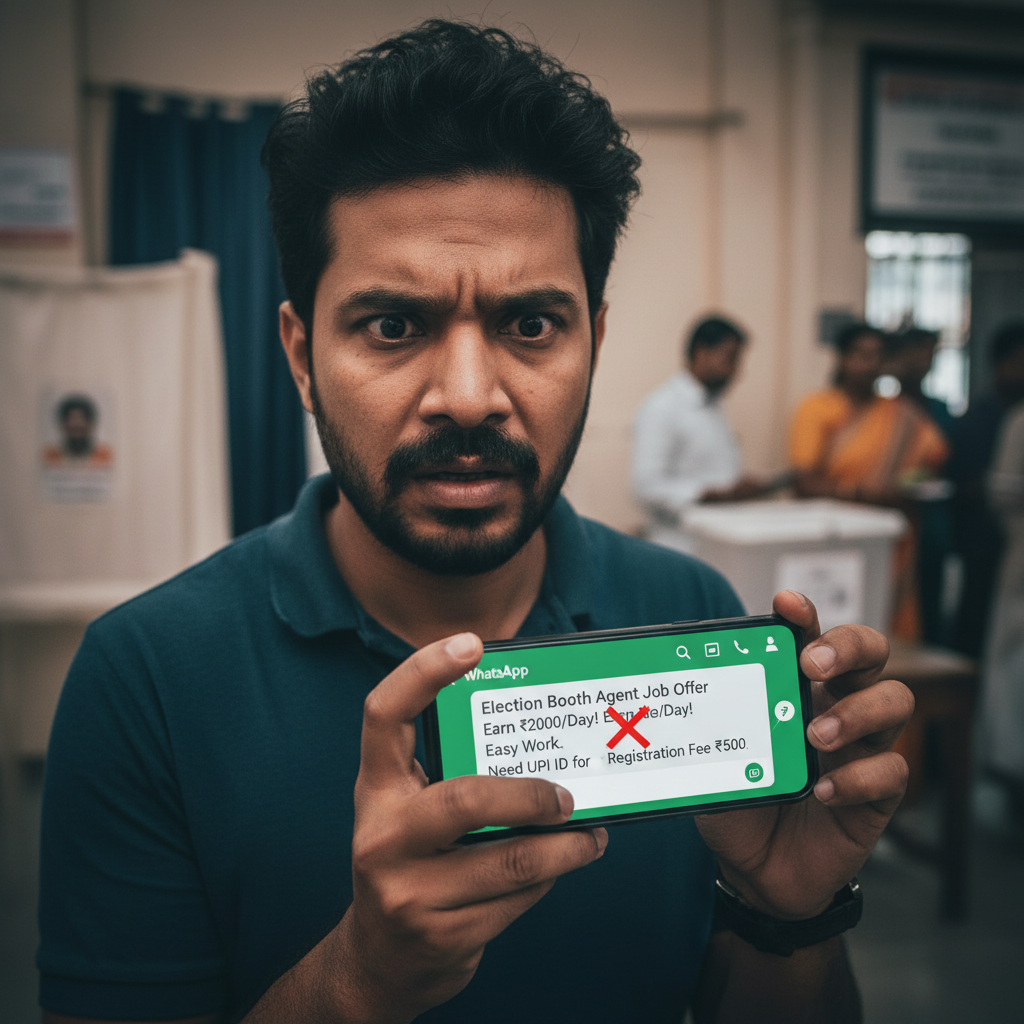
WhatsApp Election Booth Agent job real or fake — how to check?
Beware of fraudulent job offers circulating on WhatsApp and social media platforms for 'Election Booth Agents' or 'Counting Agents' promising high daily wages. Scammers lure job seekers with lucrative prospects, only to demand a small 'registration' or 'kit' fee via UPI, disappearing once paid.
How This Scam Works
As India gears up for or is in the midst of elections, a new wave of scams is targeting unsuspecting job seekers across the nation. The 'Fake Election Booth Agent Job Scam' preys on the enthusiasm and need for temporary employment during this busy period. Here's a step-by-step breakdown of how these fraudsters operate: 1. **The Initial Lure:** You might receive an unsolicited WhatsApp message or stumble upon a captivating post on platforms like Facebook or Instagram. These messages advertise attractive, temporary roles such as 'Election Booth Agent,' 'Polling Officer Assistant,' or 'Election Counting Agent.' The bait is often the promise of incredibly high daily wages, ranging from ₹5,000 to ₹15,000, which is significantly more than typical election-related temporary work. The urgency is also highlighted, stating positions are limited and filling fast due to the ongoing elections. 2. **The "Application" Process:** Interested individuals are usually directed to click a link, fill out a basic form, or reply directly to the message. The process is made to seem incredibly simple, requiring minimal documentation initially, which should raise an immediate red flag. They might ask for basic details like name, district, and contact number. 3. **The "Selection" Notification:** Within a surprisingly short period – sometimes minutes or hours – the victim receives a message congratulating them on their "selection" for the role. This quick selection, without a proper interview or background check, is designed to build trust and excitement. They might even send a fake "offer letter" or "appointment letter" that looks superficially official but lacks genuine government seals or verifiable contact information. 4. **The Pretext for Payment:** This is the crux of the scam. To "secure" the position, "activate" their ID, "order" a uniform/kit, or "process" their registration, the victim is asked to pay a small, seemingly nominal fee. This fee typically ranges from ₹200 to ₹1,000. The scammers insist this payment is mandatory and urgent, often stating that without it, the job cannot be confirmed. 5. **The UPI Transfer:** The payment method is almost exclusively UPI (Unified Payments Interface). Scammers will provide a UPI ID or a QR code and pressure the victim to make an immediate transfer. They might even guide the victim through the UPI app, instructing them on how to send the money. Some might ask for bank details under the guise of "salary processing" but ultimately still demand the small upfront fee. 6. **The Disappearance:** Once the payment is made, the scammers either stop responding to messages, block the victim's number, or the social media account disappears. The promised job never materializes, and the victim is left out of pocket, with no recourse, and their personal information potentially compromised. They might also attempt follow-up scams, claiming there's an "issue" with the initial payment and demanding more money.
Red Flags
- Unsolicited Job Offers with Exaggerated Pay:** Be wary of messages or posts offering incredibly high daily wages (₹5,000-₹15,000) for simple, temporary election-related work, especially if you haven't applied for it. Government election duties rarely pay such sums for basic roles.
- Request for Upfront "Registration" or "Kit" Fees:** Any legitimate government or political party-related recruitment will *never* ask for an upfront payment for registration, uniform, kit, or background checks. This is the biggest red flag.
- Lack of Formal Application Process/Interview:** Genuine job opportunities, even temporary ones, usually involve a proper application form, verification, and sometimes an interview process, not instant selection via WhatsApp.
- Pressure for Immediate Payment via UPI:** Scammers create a sense of urgency, pressuring you to make an immediate UPI payment, often claiming limited spots or deadlines.
- Generic or Unverifiable Contact Information:** The contact details provided might be just a mobile number, a generic Gmail ID, or a social media profile with very little history. Official communications would come from government domains or verifiable party offices.
- Grammatical Errors and Poor Language:** While not always definitive, many scam messages contain spelling mistakes, grammatical errors, or awkwardly phrased sentences.
- No Official Sources:** The job offer is not linked to any official government election commission website, a recognized political party's official career portal, or a reputable job board.
How to Stay Safe
- Verify Everything:** Always cross-reference any job offer with official sources. Check the Election Commission of India's (ECI) website or the official websites of recognized political parties. If it's not there, it's likely a scam.
- Never Pay for a Job:** A legitimate employer will never ask you to pay money to get a job. If someone asks for a "registration fee," "kit fee," "security deposit," or any other upfront payment, it is a scam.
- Be Skeptical of "Too Good to Be True" Offers:** If the daily pay seems unusually high for the nature of the work, it almost certainly is too good to be true. Research typical wages for election-related temporary roles.
- Guard Your Personal Information:** Be extremely cautious about sharing personal details like Aadhaar number, PAN, bank account details, or OTPs, especially if you haven't verified the recruiter's legitimacy.
- Block and Report:** If you receive such a message or see such a post, immediately block the sender/account and report it to the platform (WhatsApp, Facebook, Instagram).
- Use Reverse Image Search:** If they provide "identity cards" or "official letters," try a reverse image search to see if the images are stock photos or stolen from legitimate sources.
- Inform Others:** Share awareness about this scam with family and friends, especially those actively looking for employment or who might be less tech-savvy.
If You Are Targeted
- Do Not Engage or Pay:** The most crucial step is to *not* make any payment or share any sensitive information. Immediately stop all communication.
- Block the Sender:** Block the phone number on WhatsApp and report the message as spam. If it's on social media, report the post and the account.
- Collect Evidence:** Take screenshots of the messages, posts, UPI IDs, and any "official letters" they might have sent. This evidence will be vital if you decide to report the crime.
- Report to Cybercrime (if you paid):** If you have already made a payment, however small, immediately report the incident to the National Cybercrime Reporting Portal at www.cybercrime.gov.in or call their helpline at 1930. Provide all the evidence you have collected.
- Inform Your Bank/UPI Provider:** If you transferred money via UPI, contact your bank and your UPI service provider (e.g., Google Pay, PhonePe, Paytm) immediately. They might be able to initiate a chargeback or freeze the scammer's account if you act quickly.
- Change Passwords:** If you shared any account details or filled out any forms, consider changing passwords for relevant online accounts as a precautionary measure.
ScamGuard24 Insight
This scam thrives on the combination of immediate financial need, civic enthusiasm during elections, and the perceived ease of temporary work. The relatively small "registration" fee makes victims less suspicious, often dismissing it as a minor cost to secure a lucrative opportunity.
Suspect a scam right now?
Open ScamGuard24 ScannerRecommended protection tools
AffiliateWe may earn a small commission if you sign up — it never changes our editorial picks.
India's most trusted antivirus. Blocks malicious APKs, UPI phishing and fake banking apps.
Get Quick HealAll-in-one mobile security + VPN. Stops phishing links shared on WhatsApp and SMS.
Try Norton 360Stop reusing passwords. Auto-fills only on the real bank site, never on phishing pages.
Get NordPassRelated alerts
 HIGH RISK
WhatsApp Ghar Ghar Nari Shakti loan is fake? What to do
 HIGH RISK
WhatsApp election prediction betting app fraud India - what to do?
 HIGH RISK
Comments
Be the first to comment.