WhatsApp Ghar Ghar Nari Shakti loan is fake? What to do
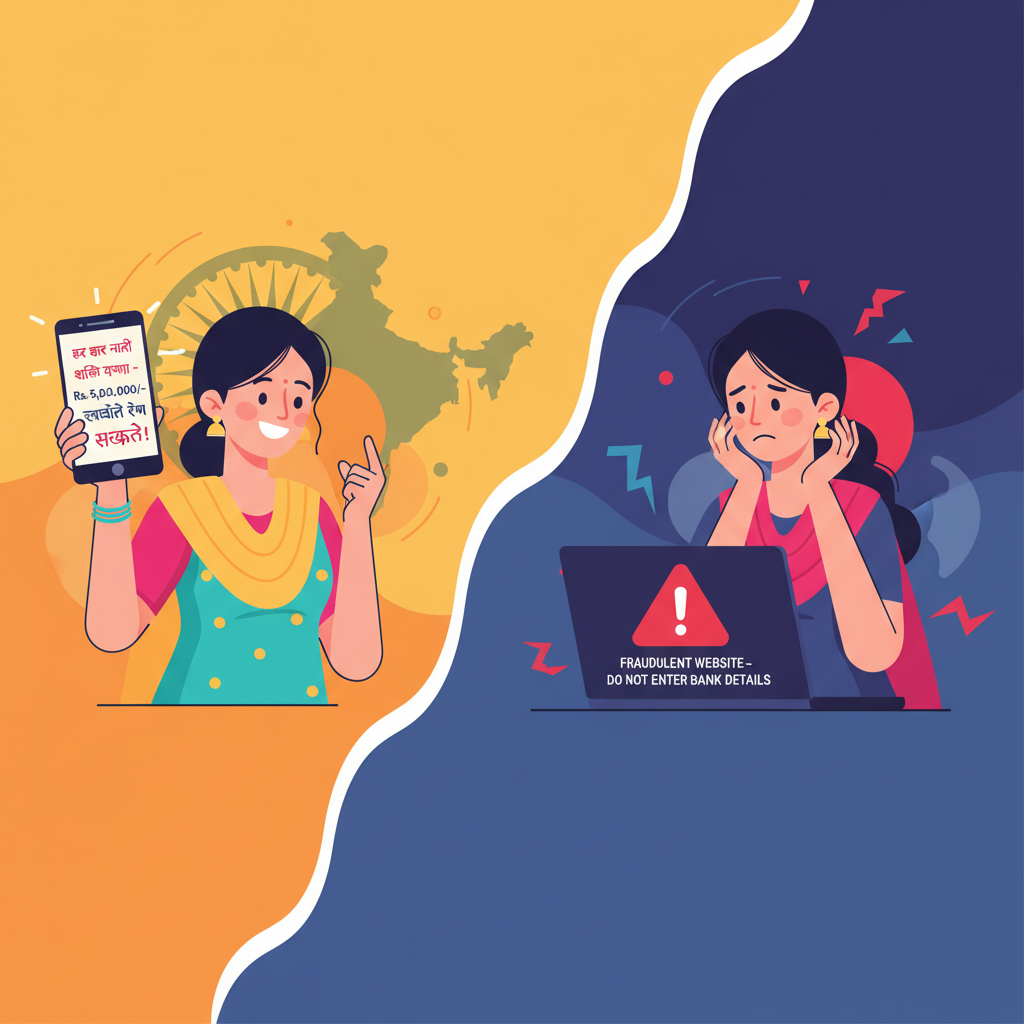
Beware of a widespread scam targeting women entrepreneurs with promises of easy government loans or subsidies under a fake 'Ghar Ghar Nari Shakti' scheme. Scammers use WhatsApp and social media to lure victims into clicking malicious links or calling fake helplines, ultimately demanding 'processing fees' and stealing personal data.
How This Scam Works
This scam preys on the aspirations of women entrepreneurs and homemakers looking for financial assistance to start or expand their ventures. You might encounter this scam through various channels. * **WhatsApp Messages:** You receive an unsolicited message on WhatsApp, often from an unknown number, excitedly announcing the launch of the 'Ghar Ghar Nari Shakti Yojana'. The message will highlight attractive features like easy approval, no collateral, and substantial loan or subsidy amounts (e.g., ₹1 lakh to ₹5 lakh). It will include a link to a supposed 'official' registration portal or a contact number. * **Social Media Ads:** Scammers create sponsored posts or attractive ads on platforms like Facebook and Instagram. These ads feature compelling graphics, testimonials, and urgent calls to action, all promoting the 'Ghar Ghar Nari Shakti' scheme. Clicking on these ads directs you to a fraudulent website designed to mimic a government portal. * **The Lure:** The central theme is a government-backed scheme offering financial aid specifically for women. The amounts promised are significant enough to be enticing but not so large as to be immediately unbelievable. * **The Trap - Registration & Fees:** Once you click the link or call the number, you'll be directed to a fake website or speak to a scammer impersonating a government official. You'll be asked to 'register' by providing extensive personal information, including your full name, address, Aadhaar number, PAN details, bank account information, and sometimes even your photo. Crucially, at some point, you will be asked to pay a "small, refundable processing fee," "application fee," "GST," or "insurance premium" – typically ranging from a few hundred to a few thousand rupees. This fee might be demanded via UPI, net banking, or even by sharing OTPs (One-Time Passwords). * **Data Theft and Financial Loss:** Once you pay the fee, the scammers either disappear or continue to demand more fees under various pretexts (e.g., "tax clearance," "legal fees"). Your personal data collected during the 'registration' process can be used for identity theft, creating fake accounts, or other fraudulent activities. The promised loan or subsidy never materializes.
Red Flags
- Unsolicited Messages/Ads:** You receive information about a government scheme without having applied for it or sought information.
- Guaranteed Loans/Subsidies:** Any scheme promising guaranteed loans or subsidies without rigorous checks, collateral, or proper documentation is highly suspicious. Government schemes have eligibility criteria and a transparent application process.
- Request for Upfront Fees:** Legitimate government schemes or financial institutions *never* ask for an upfront 'processing fee,' 'security deposit,' or 'insurance premium' before disbursing a loan or subsidy.
- Suspicious Links/Websites:** The URL might look similar to a government website but will have slight variations (e.g., '.xyz' instead of '.gov.in', or misspelled words). It won't have the secure 'https://' padlock symbol consistently.
- Demands for Sensitive Personal Information:** While government schemes require KYC, be wary if they ask for excessive personal details or financial information (like your bank account password or UPI PIN) through unverified channels.
- Urgency and Pressure Tactics:** Scammers often create a sense of urgency, pressuring you to act quickly before the "limited-time offer" expires.
- Poor Grammar/Spelling:** Official communications generally have professional language. Scam messages often contain grammatical errors, spelling mistakes, or awkward phrasing.
- No Official Announcement:** A major government scheme like 'Ghar Ghar Nari Shakti' would be widely announced by official government channels (e.g., PIB, official ministry websites, national news). If you can't find it on legitimate government portals, it's fake.
How to Stay Safe
- Verify Everything:** Before clicking any link or sharing information, always verify the authenticity of the scheme. Check official government websites (e.g., pib.gov.in, specific ministry websites like Ministry of Women and Child Development), national news outlets, or use the official MyGov India platform.
- Never Pay Upfront Fees:** Remember, legitimate government schemes or banks will *never* ask for an upfront fee for processing a loan or subsidy.
- Protect Personal Information:** Be extremely cautious about sharing your Aadhaar, PAN, bank account details, or OTPs. No legitimate entity will ask for your UPI PIN or bank password.
- Examine Links Carefully:** Hover over links before clicking to see the actual URL. Look for 'https://' and ensure the domain name is legitimate (.gov.in, .nic.in).
- Report Suspicious Messages/Ads:** Block the sender on WhatsApp, report the post on social media platforms (Facebook, Instagram), and alert cybersecurity authorities.
- Educate Yourself:** Stay informed about common scam tactics. Share this information with family and friends, especially vulnerable individuals.
If You Are Targeted
- Do Not Engage Further:** If you suspect it's a scam, immediately stop all communication with the scammer. Do not pay any money or share any more information.
- Block and Report:** Block the WhatsApp number or social media profile that contacted you. Report the incident to the platform where you encountered the scam.
- Contact Your Bank:** If you have already made a payment or shared bank details, contact your bank immediately to report the fraudulent transaction and see if it can be reversed or your account secured.
- Change Passwords:** If you shared any login credentials (even if you think they were for a fake site), change your passwords for important accounts (email, banking, social media) as a precaution.
- Report to Cybercrime:** File a complaint on the National Cybercrime Reporting Portal (cybercrime.gov.in) or call the helpline at 1930. Provide all details including screenshots of messages, transaction IDs, and website URLs.
- Monitor Your Finances:** Keep a close eye on your bank statements and credit reports for any suspicious activity.
ScamGuard24 Insight
The 'Ghar Ghar Nari Shakti' scam is a classic example of social engineering, exploiting trust in government initiatives and the economic aspirations of individuals. Scammers leverage the perceived authority of a government name to bypass critical thinking, making vigilance and cross-verification paramount for anyone encountering such offers.
Suspect a scam right now?
Open ScamGuard24 ScannerRecommended protection tools
AffiliateWe may earn a small commission if you sign up — it never changes our editorial picks.
India's most trusted antivirus. Blocks malicious APKs, UPI phishing and fake banking apps.
Get Quick HealAll-in-one mobile security + VPN. Stops phishing links shared on WhatsApp and SMS.
Try Norton 360Stop reusing passwords. Auto-fills only on the real bank site, never on phishing pages.
Get NordPassRelated alerts
 HIGH RISK
WhatsApp election prediction betting app fraud India - what to do?
 HIGH RISK
Telegram crypto investment 30% monthly returns India scam – is it real?
 HIGH RISK
Comments
Be the first to comment.