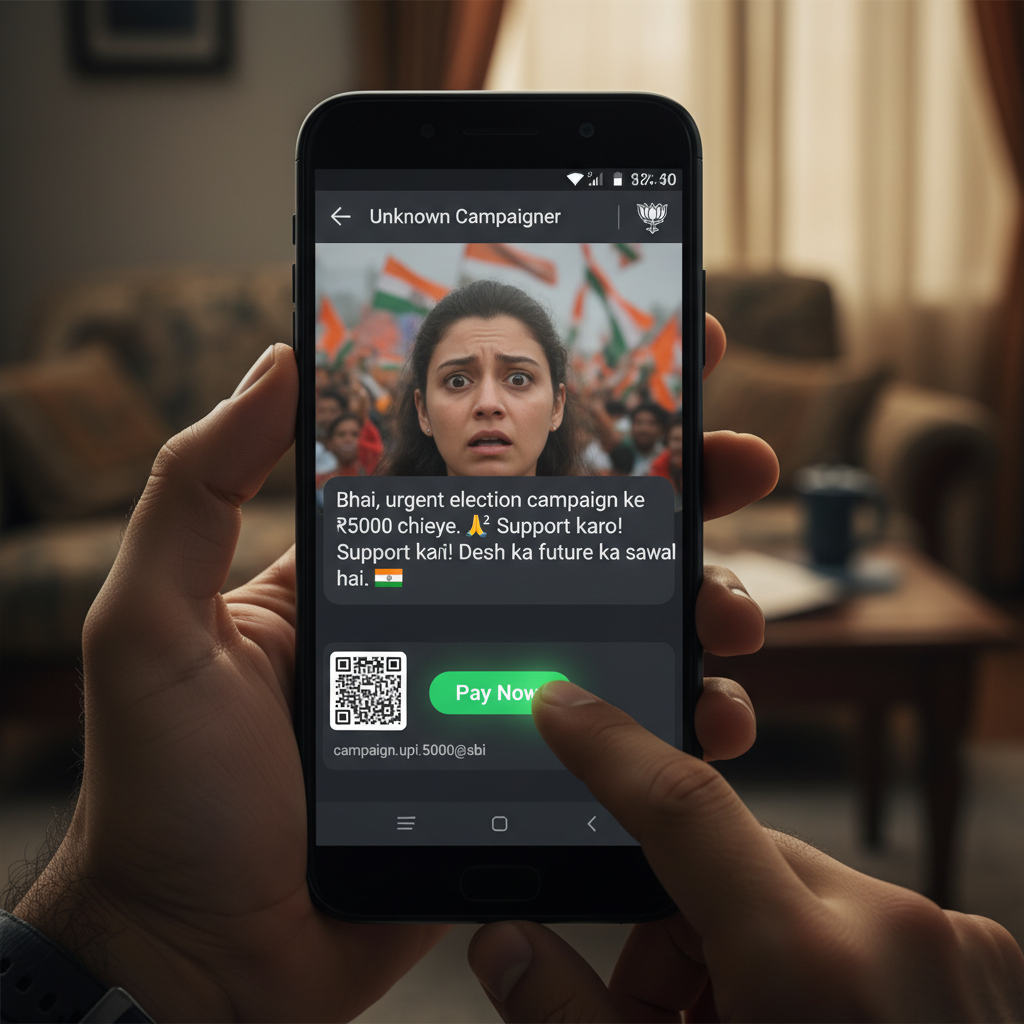
WhatsApp politician donation request UPI scam India - what to do?
Be extremely wary of unsolicited messages on WhatsApp or SMS asking for political donations via UPI. Scammers are exploiting election fervor by impersonating candidates or party workers, promising future benefits in exchange for immediate funds. This scam is designed to trick you into transferring money directly to fraudsters.
How This Scam Works
As India gears up for various elections, from local panchayat polls to state assemblies and the Lok Sabha, the digital landscape becomes fertile ground for scammers. This particular scam preys on citizens' civic duty, political affiliations, and sometimes even their desire for personal gain. Here's a step-by-step breakdown: 1. **Impersonation and Initial Contact:** You receive a message, most commonly on WhatsApp or via SMS, from an unknown number. The sender claims to be a local politician, a candidate's assistant, a party worker, or even a 'volunteer' from a prominent political party. They often use a display picture that *looks* official, perhaps a photo of a well-known leader or a party symbol. The message might start with a seemingly friendly greeting in Hinglish, like "Jai Hind!" or "Namaste, bhai/behen." 2. **The Urgent Appeal for Funds:** The core of the scam is a request for a donation, typically a specific amount like ₹500, ₹1000, or ₹5000, to support their "urgent election campaign needs." They might cite reasons such as needing funds for campaigning materials, public meetings, or even supporting needy party workers. The urgency is often highlighted, implying that the election is approaching fast and every contribution counts. 3. **Promise of Future Benefits:** To sweeten the deal and induce compliance, the scammer often promises some form of future benefit. This could range from "priority access" to government schemes after winning, an "assurance of help" with local issues, or even a vague promise of a "return on your investment" when the party comes to power. They tap into the Indian psyche where political connections are often seen as beneficial. 4. **UPI as the Preferred Payment Method:** The message invariably includes a UPI ID, a QR code, or even a link that directs you to make the payment via a UPI app (Google Pay, PhonePe, Paytm, etc.). UPI is favored by scammers due to its instant transfer nature and the relative ease with which new accounts can be set up, making it harder to trace the money once transferred. 5. **Psychological Manipulation:** Scammers leverage patriotism, political loyalty, and sometimes even fear (e.g., implying that not contributing might be noted) to pressure victims. The perceived 'authority' of a political figure, even if fake, can make people drop their guard. They bank on the victim's immediate emotional reaction over critical thinking. 6. **The Vanishing Act:** Once the payment is made, the scammer often blocks the victim, changes their number, or simply stops responding. The promised benefits never materialise, and the money is lost forever, as UPI transactions are generally irreversible.
Red Flags
- Unsolicited Messages from Unknown Numbers:** Genuine political campaigns usually have official, publicised channels for donations, not random WhatsApp messages from unknown numbers.
- Requests for UPI Payments from Personal IDs:** Legitimate political parties or candidates have official bank accounts and donation portals. A request to send money to a personal UPI ID or an obscure QR code should immediately raise suspicion.
- Promises of Future Benefits for Donations:** While political parties might offer general benefits in their manifestos, promising specific, personal benefits or "returns" for a donation is highly irregular and often illegal, pointing to a scam.
- Pressure for Immediate Payment:** Scammers often create a sense of urgency to prevent you from thinking critically or verifying the request.
- Poor Grammar, Spelling, or Vague Language:** While not always present, inconsistencies in language, awkward phrasing, or generic greetings can be a sign of a scammer.
- Lack of Official Verification:** The message doesn't come from a verified political handle or an officially announced campaign number. There's no link to an official website for verification.
How to Stay Safe
- Verify the Source Directly:** If you receive such a request, do not respond directly to the message. Instead, search for the official website or social media handles of the politician or party mentioned. Check their official donation channels, which will always be secure and publicised.
- Never Make Unsolicited UPI Payments:** Treat any unexpected request for money via UPI with extreme caution. Remember, you should only initiate payments to known and verified recipients.
- Be Skeptical of Promises:** No legitimate political campaign will promise individual benefits or "returns" in exchange for a donation. Understand that donations are voluntary contributions, not investments with guaranteed payouts.
- Report and Block:** Immediately report the number to WhatsApp (or your SMS provider) and block the sender. This helps protect others and informs the platform about malicious activity.
- Educate Yourself and Others:** Share awareness about such scams with your family, friends, and local community. Many elderly individuals or those less tech-savvy are particularly vulnerable.
- Use Official Donation Channels Only:** If you genuinely wish to donate to a political party, do so through their officially designated and secure online portals or bank accounts, which are publicly available on their websites.
If You Are Targeted
- Do NOT Engage Further:** Do not reply to the message, call the number back, or click on any links. Engaging might confirm your number is active and make you a target for more scams.
- Do NOT Make Any Payment:** Absolutely avoid transferring any money via UPI or any other method. Once the money is sent, it's extremely difficult to recover.
- Report to Cybercrime.gov.in:** Immediately file a complaint on the National Cybercrime Reporting Portal (cybercrime.gov.in) or call the helpline number 1930. Provide all details, including screenshots of the message, the scammer's number, and the UPI ID if available.
- Inform Your Bank/UPI Provider (if you've paid):** If you unfortunately fell victim and made a payment, contact your bank and your UPI app's customer support immediately. While recovery is not guaranteed, reporting quickly can sometimes help.
- Block the Scammer:** Block the number on WhatsApp and your phone. This prevents further attempts from that specific scammer.
- Screenshot Everything:** Take screenshots of the messages, the scammer's profile, the UPI ID, and any other relevant information. This evidence will be crucial for your report.
ScamGuard24 Insight
This scam thrives on the emotional connection citizens have with politics and the general election fervor in India. Scammers exploit trust and civic spirit, weaponizing readily available personal information and the ease of digital payments to extract money. Always remember that legitimate fundraising efforts will always direct you to official, verifiable channels, not personal UPI IDs.
Suspect a scam right now?
Open ScamGuard24 ScannerRecommended protection tools
AffiliateWe may earn a small commission if you sign up — it never changes our editorial picks.
India's most trusted antivirus. Blocks malicious APKs, UPI phishing and fake banking apps.
Get Quick HealAll-in-one mobile security + VPN. Stops phishing links shared on WhatsApp and SMS.
Try Norton 360Stop reusing passwords. Auto-fills only on the real bank site, never on phishing pages.
Get NordPassRelated alerts
 HIGH RISK
Instagram/WhatsApp task scam, invest money daily return, is it real?
 HIGH RISK
Fake Aadhaar Update Centre near me — is it real? How to check?
 HIGH RISK
Comments
Be the first to comment.