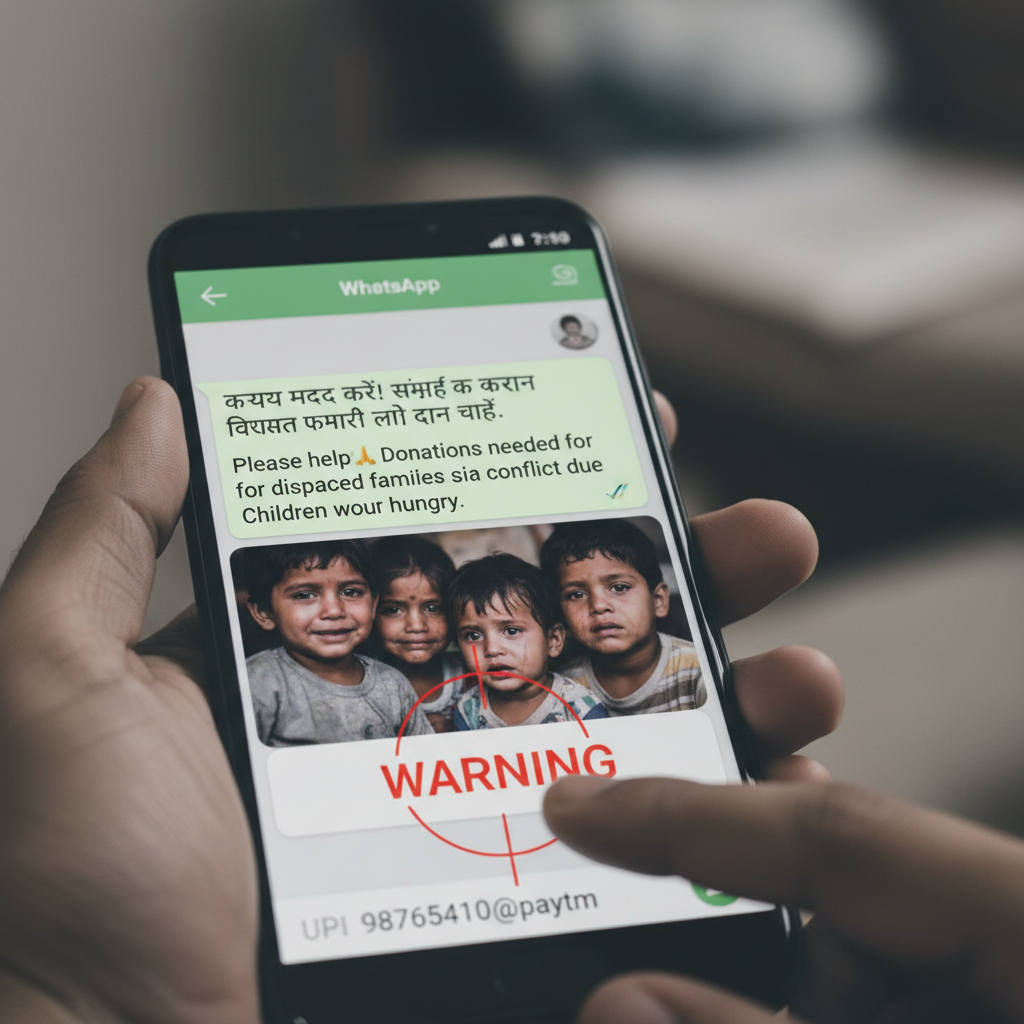
WhatsApp Iran-Israel War Charity scam UPI donation - how to check if it's real?
Be alert to a new scam circulating on WhatsApp and Instagram, exploiting the ongoing conflict between Iran and Israel. Scammers are soliciting UPI donations for "displaced families and children" through seemingly legitimate posts and images, but funds are directed to personal accounts. This is a high-risk scam designed to exploit your compassion.
How This Scam Works
The scam begins with emotionally charged messages, often forwarded on platforms like WhatsApp or shared as posts on Instagram. These messages typically feature distressed images and videos, purportedly showing the suffering of individuals, especially children, affected by the Iran-Israel conflict. The language used is designed to evoke strong feelings of empathy and urgency, pleading for immediate financial assistance to help these "displaced families" or "war victims." The call to action is always a request for donations via UPI. Scammers will provide a UPI ID, which, upon closer inspection, will invariably be a personal UPI ID (e.g., `[phone number]@paytm`, `[name]@upi`, or `[email]@okicici`) rather than an official organizational account. They might also link to what looks like a genuine news article or charity page to lend an air of authenticity, but the donation link or UPI ID embedded within will lead to their personal account. To make their plea more convincing, they often use sophisticated tactics: * **Stolen Imagery:** They lift genuine, heartbreaking images and videos from real news reports or social media, often from unrelated conflicts or past events, and repurpose them to fit their narrative. * **Emotional Appeals:** The messages are crafted to be highly persuasive, using phrases like "every rupee counts," "help save lives," or "children are starving." * **Sense of Urgency:** They stress the immediate need for funds, discouraging any form of due diligence from potential donors. * **Fake Testimonials/Endorsements:** Sometimes, they might even fabricate small stories or testimonials from supposed beneficiaries to strengthen their appeal. * **Group Sharing:** The scam often spreads rapidly through WhatsApp groups, where one person's unwitting share can expose many others to the fraud. Once you make a payment to the provided personal UPI ID, your money goes directly into the scammer's bank account, and it's almost impossible to recover. These funds are never used for any humanitarian aid but rather for the scammer's personal enrichment.
Red Flags
- Requests for UPI Donations to Personal Accounts:** Any legitimate charity will always direct donations to an official, registered organizational account, not a personal UPI ID.
- Emotional Blackmail and Urgent Demands:** Scammers use urgent, emotionally manipulative language to rush you into donating without thinking.
- Unsolicited Messages/Posts:** If you receive a message or see a post from an unknown source or an acquaintance sharing a donation request without verification, be highly suspicious.
- Poorly Formatted Messages or Grammatical Errors:** While not always present, watch out for messages with strange formatting, typos, or grammatical mistakes, which are common in scam communications.
- Lack of Official Information:** Absence of a registered charity name, registration number, official website, or transparent financial reporting.
- Generic or Vague Charity Names:** Scammers often use generic names like "Humanitarian Aid Fund" or "Disaster Relief" without providing any verifiable details.
How to Stay Safe
- Verify Before You Donate:** Always verify any charity or donation request directly through official channels. Visit the official websites of well-known, reputable international or Indian humanitarian organizations.
- Check UPI IDs Carefully:** Before sending money, scrutinize the UPI ID. If it's a personal ID (e.g., a phone number or name followed by `@upi`, `@paytm`, `@okicici`), it's a scam. Legitimate organizations typically use official merchant IDs or bank account details.
- Be Skeptical of Emotional Appeals:** While it's natural to feel empathetic, let your head rule your heart when it comes to financial transactions for charity.
- Report Suspicious Messages/Posts:** Report any suspicious WhatsApp messages or Instagram posts to the platform directly. On WhatsApp, you can long-press the message and select 'Report'. On Instagram, use the 'Report' option on the post.
- Do Not Share Widely:** Avoid forwarding suspicious messages or posts, even if your intention is to warn others. Sharing misinformation can inadvertently help the scam spread.
- Educate Yourself and Others:** Share information about this and similar scams with your friends and family, especially those who might be less tech-savvy.
If You Are Targeted
- Do NOT Send Any Money:** The most crucial step is to refrain from making any donation to the suspicious UPI ID.
- Block the Sender:** Immediately block the WhatsApp number or Instagram account from which you received the scam message/post.
- Report to Platform:** Report the scam to WhatsApp and Instagram. This helps the platforms identify and remove fraudulent accounts.
- Inform Law Enforcement:** If you have already lost money, report the incident to the National Cybercrime Reporting Portal (cybercrime.gov.in) or call their helpline at 1930. Provide all details, including the UPI ID, screenshots, and conversation history.
- Contact Your Bank/UPI Provider (if money lost):** If you transferred funds, contact your bank and your UPI service provider immediately to report the fraudulent transaction. They may be able to initiate a freeze or reversal, though success is not guaranteed.
- Take Screenshots:** Document everything. Take screenshots of the messages, the UPI ID, and the profile of the scammer. This evidence will be vital if you decide to report it.
ScamGuard24 Insight
The high confidence score reflects the frequent exploitation of major global events for monetary gain, particularly through emotional appeals on social media. Scammers are quick to adapt, and the reach of platforms like WhatsApp and Instagram in India makes this a potent, high-risk channel for such deceptions, preying on people's compassion during crises.
Suspect a scam right now?
Open ScamGuard24 ScannerRecommended protection tools
AffiliateWe may earn a small commission if you sign up — it never changes our editorial picks.
India's most trusted antivirus. Blocks malicious APKs, UPI phishing and fake banking apps.
Get Quick HealAll-in-one mobile security + VPN. Stops phishing links shared on WhatsApp and SMS.
Try Norton 360Stop reusing passwords. Auto-fills only on the real bank site, never on phishing pages.
Get NordPassRelated alerts
 HIGH RISK
ECI voter list update SMS link — is it real, what to do?
 HIGH RISK
SMS/WhatsApp 'bank account blocked update KYC' link – what to do India 2024?
 HIGH RISK
Comments
Be the first to comment.