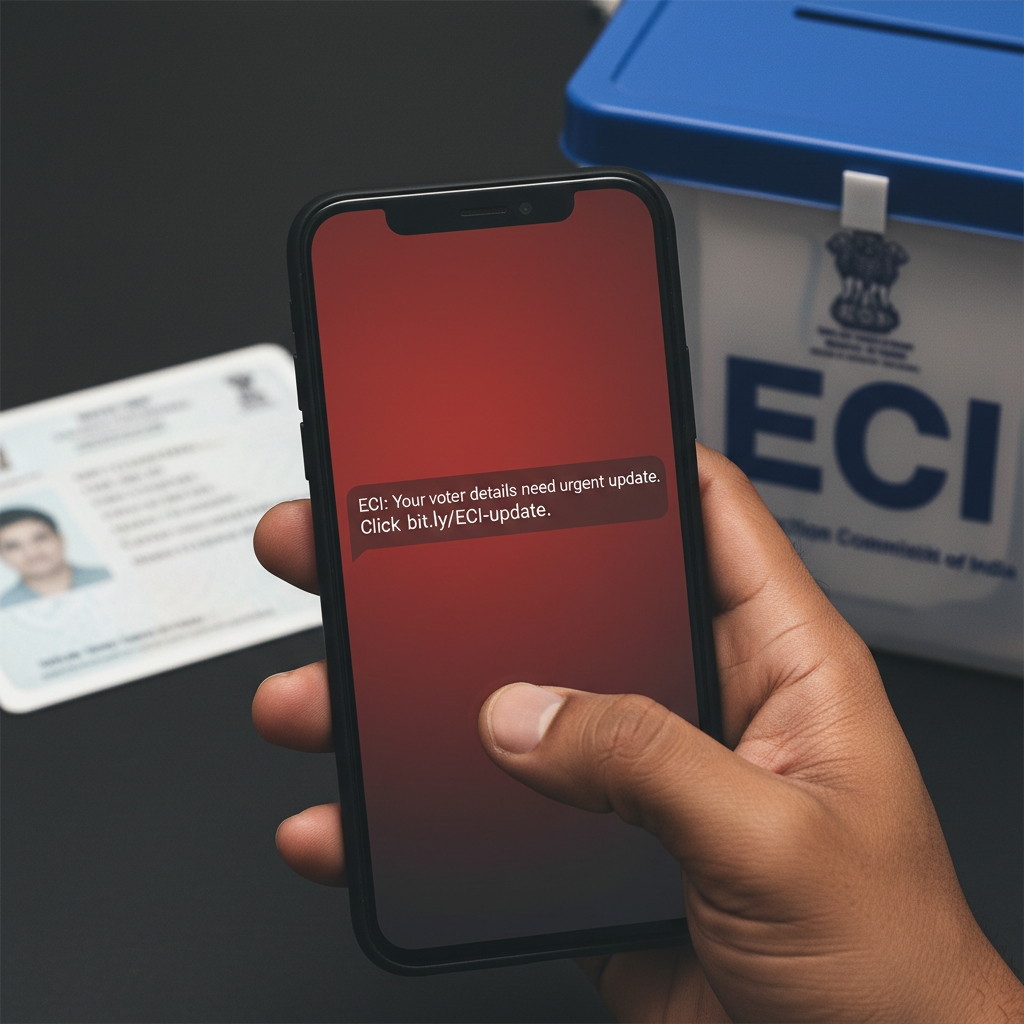
ECI voter list update SMS link — is it real, what to do?
Be cautious of SMS messages impersonating the Election Commission of India (ECI) claiming your voter details are missing or need updating. These messages typically prompt you to click a suspicious link, which can lead to phishing websites designed to steal your personal data or install malware on your device. This is a high-risk scam targeting your identity and financial security.
How This Scam Works
This scam preys on the civic responsibility and potential anxiety of Indian citizens, especially during election seasons or voter registration drives. You receive an SMS, often from an unknown or non-standard mobile number, that appears to be from the Election Commission of India (ECI). The message will typically state something alarming, such as "Your name is missing from the voter list" or "Voter ID details require immediate update." To resolve this, you are instructed to click on a provided short URL, like 'bit.ly/ECI-update' or similar. Upon clicking this link, you are redirected to a fraudulent website that meticulously mimics the official ECI portal. This fake site might ask you to enter sensitive information such as your name, date of birth, Aadhaar number, PAN details, address, or even banking credentials for "verification." In some sophisticated variants, the site might even prompt you to download a malicious app (an APK file) disguised as an "official ECI app" or "voter verification tool." This app, once installed, can grant scammers remote access to your device, steal OTPs (One-Time Passwords) from your SMS, access your contacts, or even monitor your banking applications, leading to significant financial losses. The scammers leverage urgency and the official appearance to bypass your judgment, aiming to collect enough data for identity theft, financial fraud, or even to compromise your other online accounts.
Red Flags
- Unsolicited Messages:** Any SMS from the ECI or government body that you did not explicitly request, especially those containing links, should be treated with extreme caution.
- Suspicious Sender IDs:** Look at the sender ID. Official government communications typically come from alphanumeric sender IDs (e.g., "ECI-GOV," "DG-ECI") rather than standard 10-digit mobile numbers or generic alphanumeric IDs. Scammers often use irregular numbers or slightly off-brand IDs.
- Generic or Urgent Language:** Messages using generic greetings ("Dear Citizen") instead of your name, or those creating undue urgency ("immediate action required," "your vote will be cancelled") are classic scam tactics.
- Shortened URLs:** Official government websites rarely use shortened URLs (like bit.ly, tinyurl, or custom shorteners) for critical updates. They will always provide full, legitimate website addresses (e.g., `eci.gov.in`).
- Requests for Sensitive Information via Link:** The ECI or any government body will never ask for personal details like Aadhaar, PAN, bank account numbers, or OTPs via SMS links or unofficial applications for voter list updates.
- Grammatical Errors/Typos:** While not always present, poor grammar, spelling mistakes, or awkward phrasing are often indicators of fraudulent communications.
How to Stay Safe
- Verify Directly:** If you receive such an SMS, do not click the link. Instead, independently navigate to the official Election Commission of India website (`eci.gov.in`) or the official website of your State Election Commission to verify any information. You can also contact the ECI's official helpline (1950) for confirmation.
- Never Click Suspicious Links:** Avoid clicking on any links in unsolicited SMS messages, especially those related to government services, banking, or personal details.
- Guard Personal Information:** Be extremely wary of sharing your Aadhaar number, PAN, bank account details, UPI PIN, or OTPs through any link or app prompted by an SMS. Government bodies do not request such sensitive information this way.
- Report and Delete:** Report the suspicious SMS to your mobile service provider (e.g., via the "Report Junk" feature on smartphones) and then immediately delete it. You can also forward spam SMS to 1909.
- Use Official Apps Only:** If an app is mentioned, download it ONLY from official app stores (Google Play Store or Apple App Store) and ensure it is published by the official Election Commission of India, not a third party.
- Educate Yourself:** Stay informed about common scam tactics by regularly checking official ECI announcements, cybercrime alerts from government bodies like the Ministry of Home Affairs (Cyber Dost), and reputable news sources.
If You Are Targeted
- Do Not Panic:** If you have clicked a link or entered some details, stay calm.
- Disconnect from Internet:** Immediately disconnect your device from the internet (turn off Wi-Fi and mobile data) to prevent further data transmission or malware infection.
- Change Passwords:** If you entered any passwords on the fake site, change them immediately for all accounts where you use that password. Enable Two-Factor Authentication (2FA) wherever possible.
- Monitor Accounts:** Closely monitor your bank accounts, credit card statements, and UPI transaction history for any unauthorized activity.
- Report Cybercrime:** Lodge a complaint immediately on the national cybercrime portal `www.cybercrime.gov.in` or call the national helpline number 1930. Provide all details of the SMS and the fraudulent website.
- Scan Your Device:** If you downloaded any app or APK, uninstall it immediately and perform a full scan of your device using a reputable antivirus/anti-malware software. Consider a factory reset if you suspect deep infection.
- Inform Bank:** If you shared bank details, inform your bank immediately to block accounts or cards as necessary.
ScamGuard24 Insight
This scam leverages an individual's sense of civic duty and fear of disenfranchisement, making it particularly effective in a democratic country like India. The sophistication lies in the mimicry of official ECI platforms and the use of urgency to bypass critical thinking, making it crucial for citizens to rely solely on official government channels for voter-related information.
Suspect a scam right now?
Open ScamGuard24 ScannerRecommended protection tools
AffiliateWe may earn a small commission if you sign up — it never changes our editorial picks.
India's most trusted antivirus. Blocks malicious APKs, UPI phishing and fake banking apps.
Get Quick HealAll-in-one mobile security + VPN. Stops phishing links shared on WhatsApp and SMS.
Try Norton 360Stop reusing passwords. Auto-fills only on the real bank site, never on phishing pages.
Get NordPassRelated alerts
 HIGH RISK
SMS/WhatsApp 'bank account blocked update KYC' link – what to do India 2024?
 HIGH RISK
WhatsApp Election 'rejection' link fake EC msg – what to do?
 HIGH RISK
Comments
Be the first to comment.