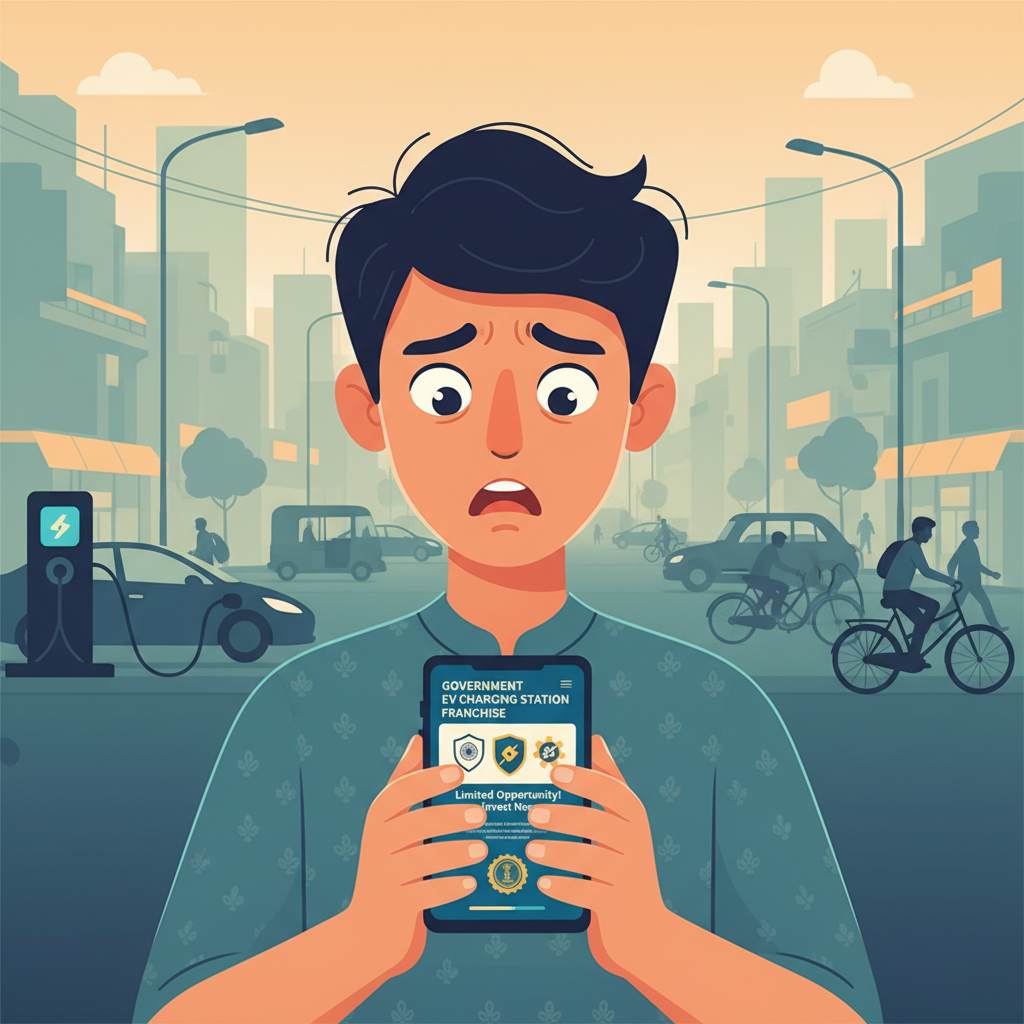
Government EV Charging Station Franchise Ad on Facebook - Is It Real?
Be extremely wary of online advertisements and messages promising lucrative returns from government-backed EV charging station franchises. Scamsters are luring aspiring entrepreneurs with fake schemes, demanding upfront payments for non-existent registrations and licenses, ultimately defrauding them of their hard-earned money. This sophisticated fraud exploits the growing interest in electric vehicles and government initiatives.
How This Scam Works
The scam typically begins with professional-looking advertisements on social media platforms like Facebook and Instagram, or through unsolicited WhatsApp messages and even direct phone calls. These ads promise high returns and a secure future by investing in a "government-approved" or "Ministry of Power-backed" EV charging station franchise. They often use official-looking logos, government emblems, and testimonials to appear legitimate. Once a victim expresses interest, they are directed to a fake website or a convincing online portal. This portal is designed to mimic a genuine government or official franchise registration site. Here, they are asked to fill out an application form and pay a relatively small initial fee, often around ₹15,000, for "registration," "site inspection," or "application processing." This payment is typically requested via UPI, bank transfer, or through a payment gateway on the fake website. After this initial payment, the scam escalates. The victim receives calls or messages from individuals posing as government officials or franchise managers. They congratulate the victim on their "selection" and then demand further payments for various fabricated reasons: "license fees," "security deposits," "equipment procurement charges," "GST," or "refundable earnest money." Each payment is accompanied by convincing but fake documents, such as forged sanction letters or Memorandum of Understanding (MoU) papers. The scamsters create a sense of urgency, pressuring victims to pay quickly to "secure their spot" or "avoid penalties." Eventually, after extracting a significant amount, the fraudsters disappear, their website becomes inaccessible, and all communication channels go dead, leaving the victim with no franchise, no refund, and a substantial financial loss.
Red Flags
- Unsolicited Offers & High Returns:** Be extremely cautious of any advertisement or message promising unusually high, guaranteed returns on investment, especially if it appears unsolicited on social media or WhatsApp.
- Upfront Payments for Government Schemes:** Genuine government schemes or franchise opportunities rarely ask for significant upfront "registration" or "processing" fees via unofficial channels. Be suspicious if they demand immediate payment via UPI or direct bank transfer without proper official invoicing.
- Pressure Tactics & Urgency:** Scammers often create a sense of urgency, pushing you to make quick decisions and payments, claiming limited slots or special discounts that expire soon.
- Unofficial Communication Channels:** While initial contact might be via social media, official communication for government-backed projects will typically involve official government emails (ending in .gov.in or similar), registered mail, and verifiable office addresses, not just WhatsApp or generic email IDs.
- Poorly Designed Websites or Generic Emails:** Inspect the website for spelling errors, grammatical mistakes, low-resolution logos, or generic contact information (like Gmail addresses). Check if the website domain name sounds suspicious or is recently registered.
- Lack of Transparent Information:** If official contact numbers don't work, physical addresses are vague or non-existent, or there's no clear information about the parent ministry/department, it's a major red flag.
How to Stay Safe
- Verify Independently:** Always cross-verify any government scheme or franchise offer directly from official government websites (e.g., Ministry of Power, NITI Aayog). Do not rely on links provided in ads or messages.
- Never Pay Upfront for Promises:** Be highly skeptical of any scheme that demands upfront payment for registration, inspection, or any initial fee before any tangible progress or official agreement.
- Check Official Sources:** If a scheme claims government backing, search for it on relevant ministry websites (e.g., Ministry of Power, MNRE). Look for official notifications, tenders, or guidelines.
- Look for Genuine Contact Information:** Call official helplines (not numbers provided in the ad) and email official government domains to confirm the authenticity of any scheme.
- Beware of Social Media Scams:** Treat advertisements on social media with extreme caution, especially those promising easy money or government contracts. Scammers often pay to promote fake ads.
- Protect Personal Information:** Never share your Aadhaar number, PAN, bank account details, or OTPs on unverified websites or with unverified callers.
If You Are Targeted
- Do Not Engage Further:** If you suspect it's a scam, immediately cease all communication with the fraudsters. Do not make any further payments or share any more personal details.
- Gather Evidence:** Collect all available evidence: screenshots of ads, WhatsApp chats, emails, transaction details (UPI IDs, bank transfer receipts), website URLs, and phone numbers.
- Report to Cybercrime:** File a complaint immediately on the National Cybercrime Reporting Portal (cybercrime.gov.in) or call their helpline at 1930. Provide all the evidence you've collected.
- Inform Your Bank/Payment Service:** If you have made any payments, contact your bank or UPI service provider immediately to report the fraudulent transaction. They might be able to help block or reverse the payment, especially if reported quickly.
- Warn Others:** Report the scam ads to the respective social media platforms (Facebook, Instagram) and share your experience with friends and family to prevent them from falling victim.
ScamGuard24 Insight
This scam cleverly leverages India's push towards electric mobility and the trust people place in government initiatives. The initial low payment is a classic bait, designed to lower inhibitions and make the victim more invested before the larger demands begin. Always remember, legitimate opportunities will follow official procedures and will never pressurize you for unofficial payments.
Suspect a scam right now?
Open ScamGuard24 ScannerRecommended protection tools
AffiliateWe may earn a small commission if you sign up — it never changes our editorial picks.
India's most trusted antivirus. Blocks malicious APKs, UPI phishing and fake banking apps.
Get Quick HealAll-in-one mobile security + VPN. Stops phishing links shared on WhatsApp and SMS.
Try Norton 360Stop reusing passwords. Auto-fills only on the real bank site, never on phishing pages.
Get NordPassRelated alerts
 HIGH RISK
Instagram/WhatsApp task scam, invest money daily return, is it real?
 HIGH RISK
Fake Aadhaar Update Centre near me — is it real? How to check?
 HIGH RISK
Comments
Be the first to comment.