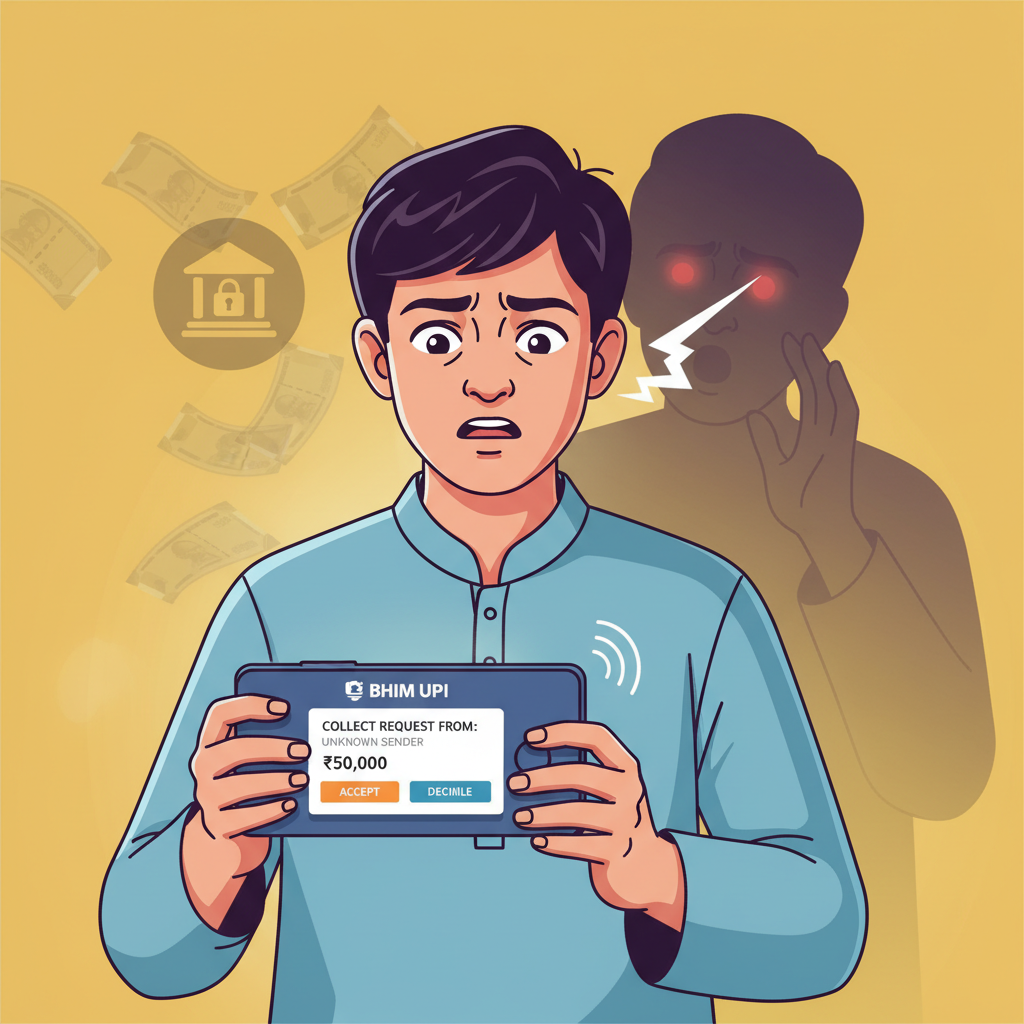
Unexpected ₹5,000 credit in bank, then UPI collect request call — what to do?
This dangerous "Jumped Deposit Scam" exploits your trust and urgency. Scammers intentionally send a small amount to your account, then quickly call, claiming it was a mistake and pressuring you to "return" the money through a fraudulent UPI collect request that actually debits your account. It’s a sophisticated method to trick you into authorising a withdrawal.
How This Scam Works
The Jumped Deposit Scam is a particularly insidious form of social engineering combined with a technical exploit, designed to bypass traditional security measures like OTPs for initial debits. Here’s a detailed breakdown of how it unfolds in the Indian context, often leveraging the ubiquitous nature of UPI: 1. **The Bait (Unsolicited Credit):** The scam begins with an unexpected credit to your bank account. This could be ₹5,000, ₹10,000, or even a smaller amount like ₹500, but always a sum large enough to get your attention. This transaction will appear legitimate on your bank statement and through SMS alerts, as the scammer genuinely transfers funds from *their* account (often a mule account or one set up with stolen credentials) to yours. The sender name might look generic or even vaguely official. This initial credit is crucial as it establishes a false sense of legitimacy and urgency. 2. **The Call (Psychological Pressure):** Within minutes, or sometimes an hour or two, of receiving the credit notification, you'll get a persistent phone call. The caller will often sound urgent, apologetic, and sometimes even a little aggressive. They'll introduce themselves as representing a bank, a merchant, or even an individual who "mistakenly" transferred the money to your account. They'll provide details of the transaction, which they know from making the initial deposit, making their claim sound highly credible. They might invent a story about a critical payment being delayed or a family emergency, escalating the pressure for you to return the funds immediately. 3. **The Trap (The "Return" Method - UPI Collect Request):** This is where the actual fraud occurs. The scammer will instruct you on how to "return" the money. Critically, **they will not ask you for your account number or an OTP for a debit from your side**. Instead, they will insist you use a "specific" method, which is typically a UPI collect request. * They might say, "Sir/Madam, I have sent you a UPI collect request. Please just approve it on your UPI app to send the money back. It's the fastest way." * They might even guide you verbally, saying "Go to PhonePe/Google Pay, look for 'Pending Requests' or 'Collect Requests'. You'll see my request for ₹5,000. Just enter your UPI PIN to approve it." * What they are *not* telling you is that accepting a "collect request" when *you are the one initiating the payment* is inherently backward. A collect request is used when someone *wants to receive money from you*. By approving their collect request and entering your UPI PIN, you are explicitly authorising a debit from your account, not initiating a payment back to them. 4. **The Outcome (Account Debited):** Once you input your UPI PIN to "approve" what you believe is a return transaction, the funds disappear from your account. The scammer, who initiated the "collect request," successfully withdraws the money you had *plus* the money they initially sent. By the time you realise what happened, the scammer has often disconnected the call and their phone number may be unreachable.
Red Flags
- Unexpected Credit:** Receiving money you weren't expecting is the first and biggest red flag. Banks don't randomly deposit money into accounts.
- Urgency and Pressure:** Any caller demanding immediate action, especially involving money, and creating a sense of panic or urgency ("return it now, it's an emergency!") is highly suspicious.
- Guiding You Through an App:** A legitimate bank or institution will never guide you step-by-step through your personal UPI app to "return" funds or rectify an error.
- Requests for UPI PIN:** Your UPI PIN is sacrosanct. You only enter it when *you* are making a payment. If someone asks you to enter it for *any other reason*, it's a scam.
- Claiming "Mistake" and Offering a "Solution":** Scammers create a problem (the mistaken deposit) and then immediately offer a seemingly simple solution that requires your action (the collect request approval).
- Unusual "Return" Instructions:** If someone tells you to "approve a collect request" to *send* money, it's backwards logic and a clear sign of fraud. Collect requests are for *receiving* money.
- Generic or Suspicious Caller ID:** While not foolproof, caller IDs that are unrecognised, from unknown numbers, or that don't match official bank numbers should raise a flag.
How to Stay Safe
- Never Act on Unexpected Credits:** If you receive an unexpected credit, do not touch the money. Inform your bank directly through official channels (customer care number on their website or your statements, or visit a branch). Let the bank handle the investigation and reversal.
- Verify, Verify, Verify:** If someone calls claiming to be from your bank or a company about a transaction, disconnect the call. Call back using the official customer care number listed on the bank's website or your passbook, not the number the caller provided.
- Know Your UPI App Features:** Understand that your UPI PIN is *only* for authorising outgoing payments. You do *not* need to enter your UPI PIN to *receive* money. If you receive a collect request you didn't initiate, simply decline it.
- Guard Your UPI PIN:** Never share your UPI PIN with anyone, under any circumstances. No bank employee, government official, or company representative will ever ask for your PIN, OTP, or full credit card details.
- Do Not Use Links/QR Codes from Unknown Sources:** If someone sends you a link or a QR code to "return" money, do not click or scan it. These can lead to phishing sites or authorise fraudulent transactions. For genuine money transfers, you initiate the payment yourself using the recipient's verified UPI ID or bank account.
- Be Skeptical of Urgency:** Take a deep breath. Scammers thrive on panic. Legitimate processes rarely demand instant action without allowing time for verification.
- Educate Those Around You:** Share this information with family and friends, especially elderly relatives who might be less familiar with digital payment nuances.
If You Are Targeted
- Do Not Engage Further:** If you suspect it's a scam call, disconnect immediately. Do not argue or try to understand their complex story.
- Do Not Share Any Information:** Do not provide any personal details, bank account numbers, UPI IDs, PINS, or OTPs.
- Decline the UPI Collect Request:** If you received an unsolicited collect request, simply decline it in your UPI app. Do NOT enter your PIN.
- Immediately Report to Your Bank:** Contact your bank's official customer service helpline or visit your nearest branch. Explain the situation clearly, providing details of the suspicious credit and the subsequent call.
- File a Police Complaint (Cybercrime):** File a complaint on the National Cybercrime Reporting Portal (cybercrime.gov.in) or by calling helpline 1930. This creates an official record and may assist in tracing the funds if money was lost.
- Keep Records:** Save screenshots of the suspicious credit, phone numbers, and any other relevant communication.
ScamGuard24 Insight
This scam preys on the victim's sense of honesty and desire to correct a "mistake." The initial real credit is a clever psychological tactic that disarms vigilance, making the subsequent fraudulent request seem less suspicious. Always remember that receiving money legitimately never requires you to input your UPI PIN.
Suspect a scam right now?
Open ScamGuard24 ScannerRecommended protection tools
AffiliateWe may earn a small commission if you sign up — it never changes our editorial picks.
India's most trusted antivirus. Blocks malicious APKs, UPI phishing and fake banking apps.
Get Quick HealAll-in-one mobile security + VPN. Stops phishing links shared on WhatsApp and SMS.
Try Norton 360Stop reusing passwords. Auto-fills only on the real bank site, never on phishing pages.
Get NordPassRelated alerts
 HIGH RISK
UPI unexpected deposit scam — caller asking to return, what to do?
 HIGH RISK
WhatsApp election duty payment pending — is it a scam? How to check in India
 HIGH RISK
Comments
Be the first to comment.