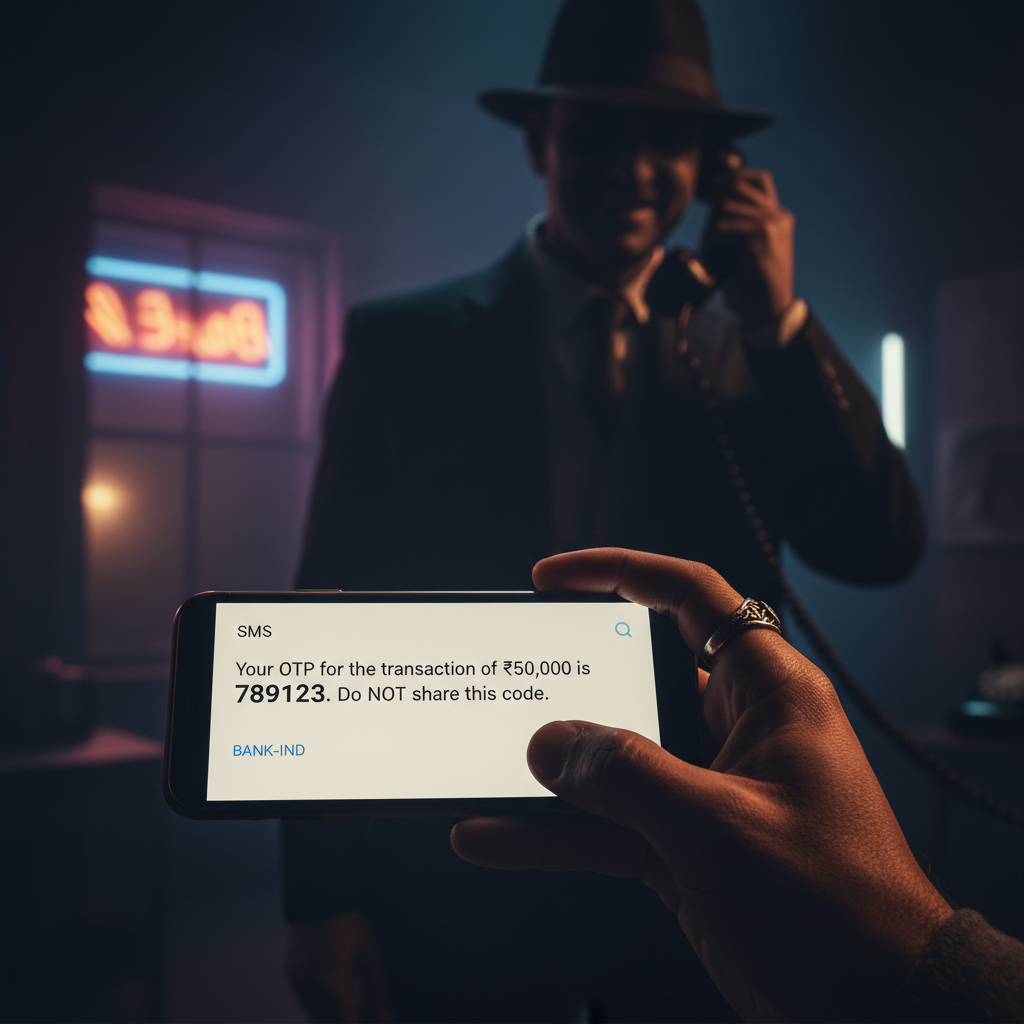
Bank caller asked for OTP — is it a scam? How to know.
A dangerous scam is circulating where imposters, pretending to be from your bank, will call you and trick you into revealing a One-Time Password (OTP) sent to your phone. Sharing this OTP gives them direct access to your bank account, leading to immediate financial loss. This is a HIGH-risk scam designed to exploit trust and urgency.
How This Scam Works
This particular scam preys on urgency, fear, and a fundamental misunderstanding of how banks operate. Here’s a detailed breakdown of the modus operandi: **1. The Impersonation:** The scam begins with a phone call. The scammer will use various techniques to appear legitimate. They might Spoof their caller ID to display your bank's name or a number that looks official. They use sophisticated voice modulation software to sound professional, sometimes even mimicking regional accents or specific bank call center tones. Their opening statement will often be something alarming, designed to create immediate panic. For example, "This is [Bank Name] security department. We've detected suspicious activity on your account," or "Your KYC is about to expire, and your account will be frozen." **2. Creating Urgency and Fear:** Once they have your attention, the scammer will escalate the urgency. They'll claim that immediate action is required to prevent your account from being blocked, suspended, or compromised. They might threaten dire consequences like "If you don't verify now, all your funds will be frozen," or "Your Aadhaar link to the bank is failing, and your account will be deactivated within hours." This pressure is crucial to disarm your critical thinking. They want you stressed and less likely to question their demands. **3. The OTP Bait – The "Verification" Trap:** This is the core of the scam. The scammer will then tell you that to "verify" your identity, to "unblock" your account, or to "update" your details, they need you to provide an OTP that will be sent to your registered mobile number. They will often use technical jargon to confuse you, saying things like, "We're sending a verification code to authenticate your session," or "Please read out the OTP to complete the security protocols." **4. The SMS Arrival – Your Personal Key:** At this moment, you will genuinely receive an SMS on your phone. This SMS *is* from your bank, but it's not for a "verification" they initiated. Instead, the scammer, while on the call with you, has secretly initiated a transaction, a password reset, or a UPI transfer from your account. The OTP you receive is the *confirmation code* for *their* fraudulent activity. The SMS will often clearly state what the OTP is for (e.g., "OTP for UPI transfer of ₹5,000 to XXXXXX," or "OTP for password reset requested on your net banking"). The scammer will quickly tell you to ignore the SMS content and just give them the numbers. **5. The Deception and Financial Loss:** If you provide the OTP, you are effectively authorizing the fraudulent transaction the scammer initiated. Within moments of you sharing that one-time password, funds will be siphoned from your bank account, new beneficiaries might be added, or your net banking credentials could be compromised. By the time you realize what has happened, it's often too late to reverse the transaction.
Red Flags
- Insistence on immediate action:** Any caller demanding that you act *right now* to prevent severe consequences (account freezing, service termination) without giving you time to think.
- Asking for an OTP over the phone:** NO legitimate bank or financial institution will EVER ask you for a full OTP over a phone call, email, or SMS. Your OTP is solely for *your* use to authenticate *your* transactions.
- Unsolicited calls about "account issues":** If you haven't recently contacted your bank about an issue, be extremely wary of calls claiming your account is compromised or needs verification.
- The caller pressures you to ignore the SMS content:** If the caller tells you to just give them the numbers from an SMS and ignore the text that says "Never share this OTP," or "OTP for payment to X," it's a guaranteed scam.
- Threatening language or fear-mongering:** Using phrases like "Your account will be blocked permanently," "You will lose all your money," or "This is your last chance."
- Requesting personal banking details:** Beyond basic identity verification (like the last few digits of your account), a legitimate bank will not ask for your full debit/credit card number, CVV, expiry date, Net Banking password, or PIN over the phone.
How to Stay Safe
- Never share your OTP:** This is the golden rule. Your OTP is personal and is the key to your bank account. Do not share it with *anyone*, regardless of who they claim to be or what they promise/threaten.
- Verify the caller independently:** If you receive a suspicious call claiming to be your bank, politely tell them you will call them back. Disconnect the call, and then use the *official customer care number* printed on your bank passbook, debit card, or your bank's official website (NOT a number provided by the suspicious caller) to verify the claim.
- Read the SMS carefully:** Always read the *entire* SMS containing the OTP. It clearly states what the OTP is for. If it mentions a transaction you didn't initiate, do not share the OTP.
- Be suspicious of unsolicited calls:** If you didn't initiate contact with your bank, treat any incoming call with caution, especially if it's about an urgent "problem."
- Banks don't block accounts without notice:** Generally, banks give ample notice for KYC updates or other account-related issues, and they follow established procedures, not emergency phone calls for OTP sharing.
- Register for SMS/Email alerts:** Ensure you have transactional SMS and email alerts enabled for all your bank accounts. This way, you'll be immediately notified of any activity.
If You Are Targeted
- Do NOT share the OTP.** If you haven't already, simply disconnect the call immediately.
- If you *have* shared the OTP:**
- Immediately call your bank's official customer care helpline and report the fraudulent transaction. Request them to block your card/account if necessary.
- File a complaint under "Consumer Fraud" at the National Cybercrime Reporting Portal: [https://cybercrime.gov.in/](https://cybercrime.gov.in/) or call their helpline at 1930. Provide all details of the call and the transaction.
- Change all your important passwords (Net Banking, UPI PIN, email frequently used for banking alerts).
- Monitor your bank statements closely for any further suspicious activity.
ScamGuard24 Insight
The OTP Sharing Trick remains highly effective because it leverages social engineering to exploit human vulnerabilities like fear, urgency, and trust in authority. Scammers have become masters at creating a convincing façade, making independent verification crucial for every Indian citizen to protect their hard-earned money.
Suspect a scam right now?
Open ScamGuard24 ScannerRecommended protection tools
AffiliateWe may earn a small commission if you sign up — it never changes our editorial picks.
India's most trusted antivirus. Blocks malicious APKs, UPI phishing and fake banking apps.
Get Quick HealAll-in-one mobile security + VPN. Stops phishing links shared on WhatsApp and SMS.
Try Norton 360Stop reusing passwords. Auto-fills only on the real bank site, never on phishing pages.
Get NordPass


Comments
Be the first to comment.