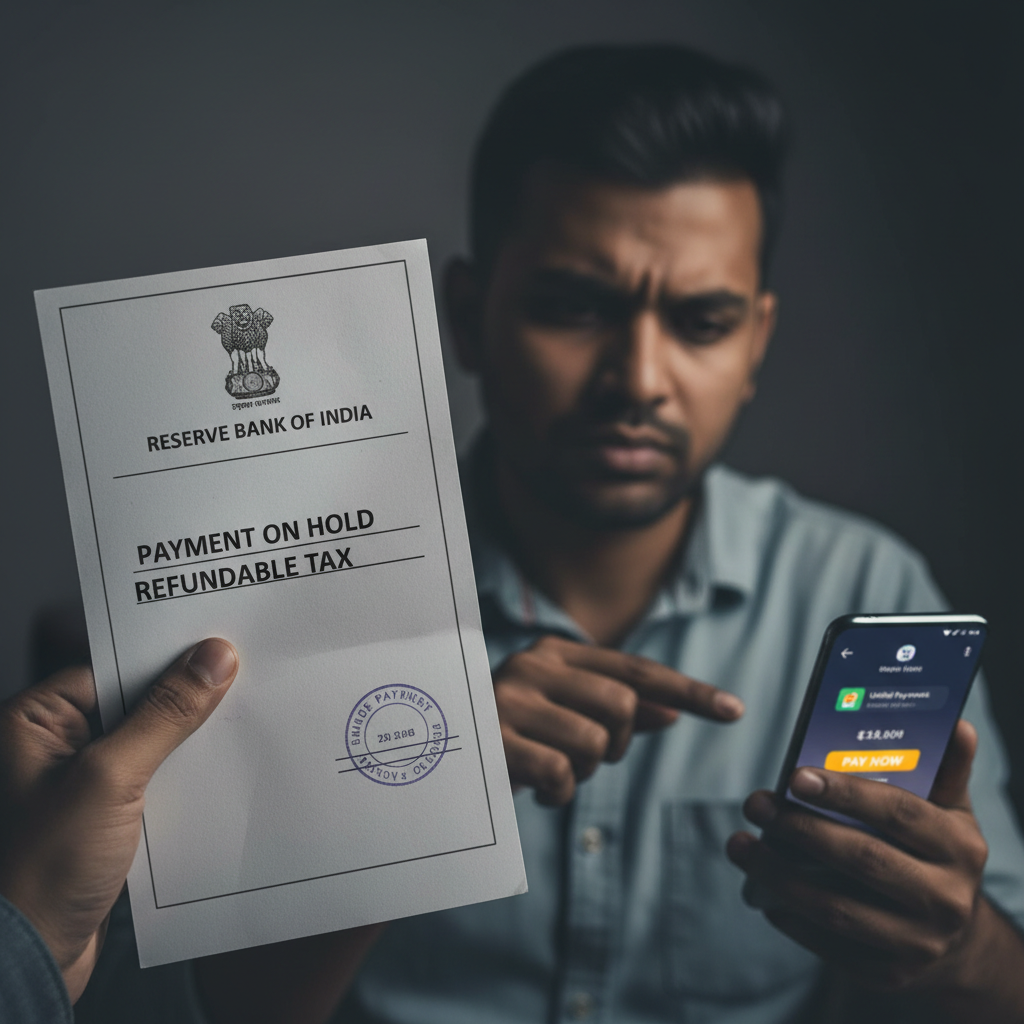
RBI refundable tax for held payment letter — is it real, how to check?
Scamsters are sending official-looking letters, emails, or social media messages pretending to be from the Reserve Bank of India (RBI) or other financial institutions. They claim a large payment is on hold and demand an immediate "refundable tax" to release it, aiming to steal your money. This scam is high-risk and targets your financial security.
How This Scam Works
Imagine you receive a meticulously crafted letter, delivered by post, or an email that lands in your inbox, seemingly from the Reserve Bank of India (RBI). The letter begins by informing you of a substantial incoming payment destined for your bank account – perhaps ₹1 Lakh as a bonus, an investment return, or even a delayed government benefit. This news is designed to pique your interest and create a sense of anticipation. However, the letter quickly introduces a problem: this payment, despite being legitimate, is currently "on hold" or "pending clearance" due to an supposed "transaction failure," a "regulatory issue," or an "unpaid refundable tax." The language used is often technical and authoritative, filled with financial jargon to appear authentic. It might even include official-looking logos, watermarks, and fake reference numbers to enhance its credibility. The crux of the scam follows: to release this substantial payment, you are required to make an immediate, smaller payment—for instance, ₹7,500. This payment is invariably labelled as a "refundable tax," an "administrative fee," or a "processing charge." The letter explicitly states that this amount is fully refundable once the main payment is processed, reinforcing the idea that it's merely a temporary hurdle. To facilitate this "refundable tax" payment, the scamsters provide specific bank account details, often including an account number, IFSC code, and the name of a beneficiary. These details are, of course, for a mule account controlled by the fraudsters. They might also instruct you to make the payment via UPI, providing a UPI ID. The urgency is often highlighted, warning that failure to pay promptly will result in the loss of the larger payment or additional penalties. The scam preys on human psychology – the desire for a windfall combined with fear of losing it. Once you transfer the ₹7,500, the scammers disappear. The promised ₹1 Lakh never materialises, and your "refundable tax" is gone forever. They might even try to extract more money later, claiming further "processing fees" or "clearance charges." This scam can also manifest via email or social media. An email might mimic official RBI correspondence, complete with hyperlinked text that leads to phishing sites designed to steal your bank credentials or personal information. On social media, you might receive direct messages or see posts promoting similar schemes, often using fake RBI accounts or profiles of seemingly legitimate financial consultants. The method of contact may differ, but the core narrative – a large payment held hostage by a small, refundable fee – remains consistent.
Red Flags
- Unsolicited Communication from RBI:** The RBI (Reserve Bank of India) primarily communicates with banks and financial institutions, not individual account holders, especially regarding specific incoming payments or taxing them directly. Any direct communication claiming to be from RBI about your personal transactions is highly suspicious.
- Demand for Upfront "Refundable Tax" or Fees:** Reputable financial institutions or government bodies will never demand an upfront "refundable tax" or fee to release legitimate payments. Any such request is a classic hallmark of a scam.
- Sense of Urgency and Threat:** The communication will often pressure you to act immediately, threatening that you'll lose the larger payment or face penalties if you don't comply quickly. This tactic is designed to bypass rational thought.
- Grammatical Errors and Generic Salutations:** While often sophisticated, scammers can make mistakes. Look for grammatical errors, awkward phrasing, or generic salutations like "Dear Customer" instead of your full name.
- Bank Details for Personal Accounts:** If the letter provides bank account details for a personal savings account or a UPI ID for an individual to make the payment, it's a huge red flag. Legitimate transactions with government bodies or large financial institutions go to corporate accounts.
- Requests for Personal Information:** Be wary if the communication asks for sensitive personal details like your Aadhaar number, PAN details, bank account passwords, or OTPs, under the guise of verification. The RBI or your bank will never ask for such information via unsolicited letters, emails, or calls.
How to Stay Safe
- Verify Directly with the Source:** If you receive such communication, NEVER use the contact details provided in the letter/email/message. Instead, independently find the official contact details for the RBI (through their official website) or your bank and call them directly to verify.
- Be Skeptical of Unsolicited Windfalls:** If you haven't applied for a payment or aren't expecting a large sum of money, be extremely wary of messages claiming you have one "on hold."
- Never Pay Unverified Fees:** Do not make any payments for "refundable taxes," "processing fees," or "clearance charges" unless you have independently verified the legitimacy of the request through official and secure channels.
- Protect Your Personal Information:** Never share your UPI PIN, ATM PIN, CVV, OTP, bank account passwords, Aadhaar, or PAN details with anyone who contacts you unsolicited, regardless of who they claim to be.
- Report Suspicious Communications:** If you receive a suspicious letter, email, or message, report it to the National Cybercrime Reporting Portal (cybercrime.gov.in) or call Helpline Number 1930.
If You Are Targeted
- Do Not Respond or Engage:** If you receive such a letter, email, or message, do not reply to it, click on any links, or call any numbers provided in the suspicious communication.
- Do Not Make Any Payments:** Under no circumstances should you transfer any money to the accounts or UPI IDs provided by the scammers.
- Collect Evidence:** Keep the suspicious letter, email, or screenshots of the social media message. This evidence will be crucial if you decide to report the incident.
- Report to Authorities:** Immediately report the scam to the cybercrime authorities via cybercrime.gov.in or helpline 1930. Provide all the evidence you’ve collected.
- Inform Your Bank:** If you inadvertently shared any bank details or made a payment, contact your bank's fraud department immediately to report the incident and potentially freeze transactions.
ScamGuard24 Insight
This scam leverages authoritative branding and the promise of a large sum to bypass critical thinking. Remember, legitimate institutions like RBI never demand upfront "refundable" payments for releasing funds to individuals; always verify independently from official sources.
Suspect a scam right now?
Open ScamGuard24 ScannerRecommended protection tools
AffiliateWe may earn a small commission if you sign up — it never changes our editorial picks.
India's most trusted antivirus. Blocks malicious APKs, UPI phishing and fake banking apps.
Get Quick HealAll-in-one mobile security + VPN. Stops phishing links shared on WhatsApp and SMS.
Try Norton 360Stop reusing passwords. Auto-fills only on the real bank site, never on phishing pages.
Get NordPassRelated alerts
 HIGH RISK
WhatsApp Election 'rejection' link fake EC msg – what to do?
 HIGH RISK
Telegram IPL fixed match betting tips scam India – what to do?
 HIGH RISK
Comments
Be the first to comment.